 Easy Tech Tuts
How To Change Leverage On Tradingview Paper Trading, Set it to Maximum 2026 Easily
By Impran M N
TradingView's paper trading account lets you simulate positions with borrowed buying power before ever risking real money, and leverage is set separately for each asset class rather than as one global number. That per-class setup is exactly where people get confused, since the option to change it sits inside an account settings panel that's easy to miss under the main chart. This guide shows where that panel actually is, what the leverage options for stocks, futures, forex, and crypto look like, and how resetting the account fits into applying new settings.
01Switch to the Paper Trading tab
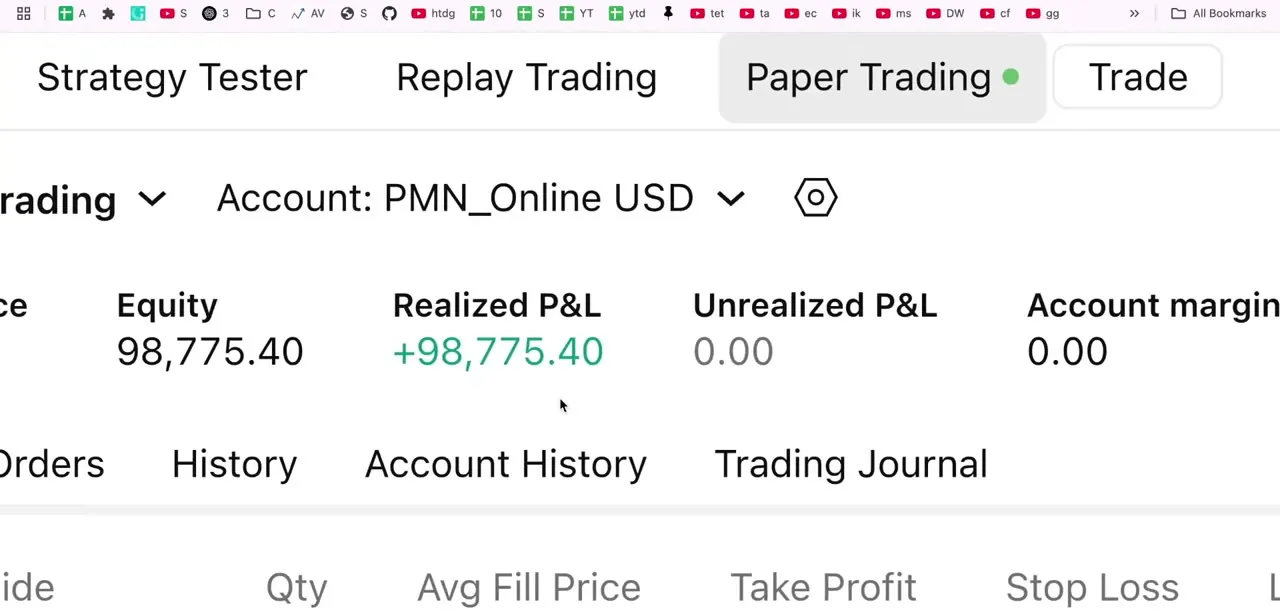
Below your chart, TradingView shows a row of trading modes: Strategy Tester, Replay Trading, Paper Trading, and Trade. Click Paper Trading to activate it — a green dot appears next to it once selected. This opens your paper account panel, which shows an Account dropdown (defaulting to a name like Account: PMN_Online USD), along with Equity, Realized P&L, Unrealized P&L, and Account margin figures, plus tabs for Orders, History, Account History, and Trading Journal.
02Open your account settings
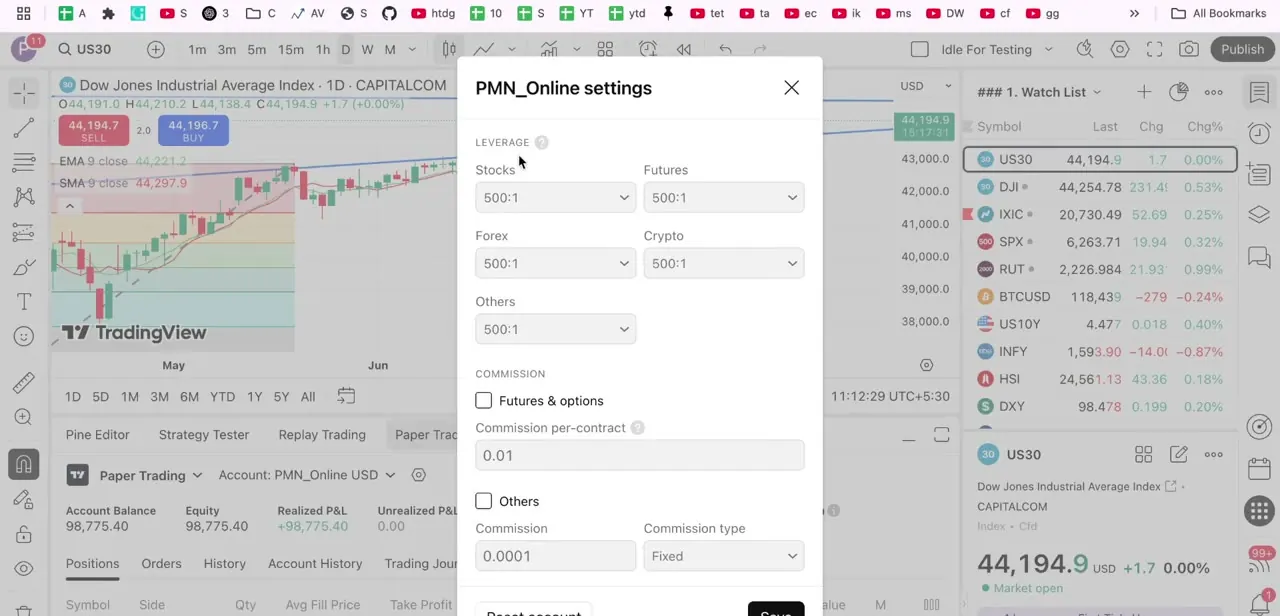
Next to the Account dropdown, a small hexagonal icon opens the settings panel for that specific paper account. Clicking it brings up a modal titled with your account's name and "settings," which is where leverage actually lives — not buried in the general TradingView preferences, but scoped to this one paper account.
03Review leverage by asset class
The settings modal has a Leverage section broken into five categories: Stocks, Futures, Forex, Crypto, and Others, each with its own dropdown showing a ratio like 500:1. These are independent settings — bumping Forex leverage doesn't touch what Futures or Crypto use, so if your strategy only trades one asset class, that's the only dropdown you actually need to adjust. Below Leverage, a Commission section lets you set a per-contract commission and toggle it on for futures & options or other instruments, which matters if you want your simulated results to reflect realistic trading costs.
04Set leverage to your target level
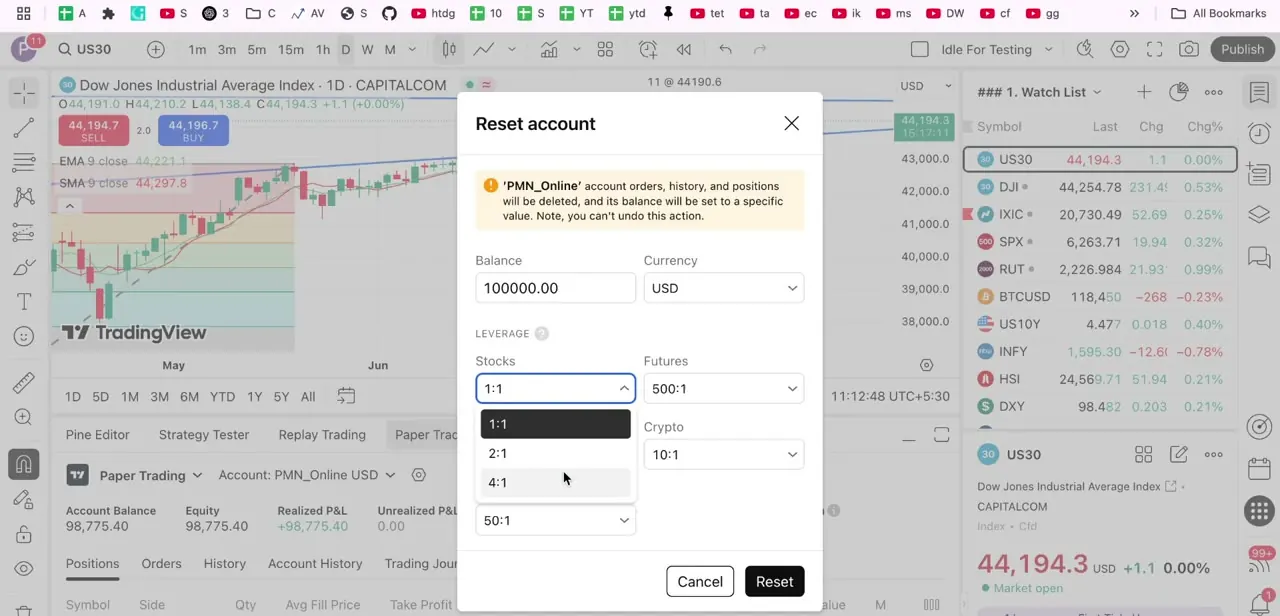
Click any of the five dropdowns and a list of ratios appears — options like 1:1, 2:1, 4:1, and 50:1 are visible before the list continues further, up to higher ratios such as 500:1 depending on the asset class. Pick the ratio that matches what you're trying to simulate: a low ratio like 1:1 or 2:1 mirrors a cash account with no borrowed buying power, while a high ratio stress-tests how a leveraged position would behave, position sizing and all, without any real capital on the line.
05Reset the account to apply the change cleanly
TradingView's Reset account dialog carries its own Balance, Currency, and Leverage fields, and reapplying leverage through this flow — rather than only saving it in account settings — clears out existing orders, history, and open positions in the process. The dialog warns plainly that this action can't be undone, so make sure you're not mid-strategy on trades you still need before confirming.
06Confirm the reset and start fresh
Set your desired starting Balance, confirm the Currency, dial in leverage per asset class one more time, and click Reset. Your paper account comes back with the balance and leverage you just set, zeroed-out P&L, and no order history — a genuinely clean slate for testing a new leverage level without any prior trades muddying the results.
Frequently asked questions
Can I change leverage on TradingView's paper trading account?
Yes — leverage is set per asset class (Stocks, Futures, Forex, Crypto, Others) from the account settings panel, reachable via the hexagon icon next to the Account dropdown in the Paper Trading tab.
Why do I need to reset my account to change leverage?
Leverage can be adjusted directly in account settings, but running it through Reset account also clears existing orders, history, and positions, giving you a clean account that matches the new settings exactly.
Is paper trading leverage the same as live trading leverage?
Paper trading leverage is a simulation setting you control freely per asset class; actual leverage on a live account depends on your real broker's rules and regulatory limits, which are often far more restrictive.
Can beginners use this feature safely?
Yes — since paper trading involves no real money, it's a safe way to experiment with different leverage ratios on stocks, futures, forex, or crypto before ever trading live.
Where do I find the leverage option?
Open the Paper Trading tab, click the hexagon settings icon next to your account name, and the Leverage section appears broken out by asset class in the modal that opens.
About the author

Impran M N
I've been hooked on technology for as long as I can remember — especially the new tools and AI apps that seem to land every other week. Easy Tech Tuts is where I write up whatever I've just worked out: I do the task in the real product, record the screen, and turn it into the guide I wish I'd found first.