 Easy Tech Tuts
How to Cash Out & Withdraw Money on Squarespace with Stripe, Paypal & Square 2026
By Impran M N
Squarespace doesn't hold your money, and that single fact explains most of the confusion around cashing out. There is no wallet inside Squarespace with a Withdraw button — sales go straight to whichever payment processor you connect, and that processor pays your bank on its own schedule.
So "withdrawing your earnings" really means connecting Stripe, PayPal, or Square correctly and getting the bank details right on their side. This guide shows where the Payments panel lives, what each of the three processors actually covers, and the settings that quietly cause delayed or failed payouts.
01Open your site's Payments settings
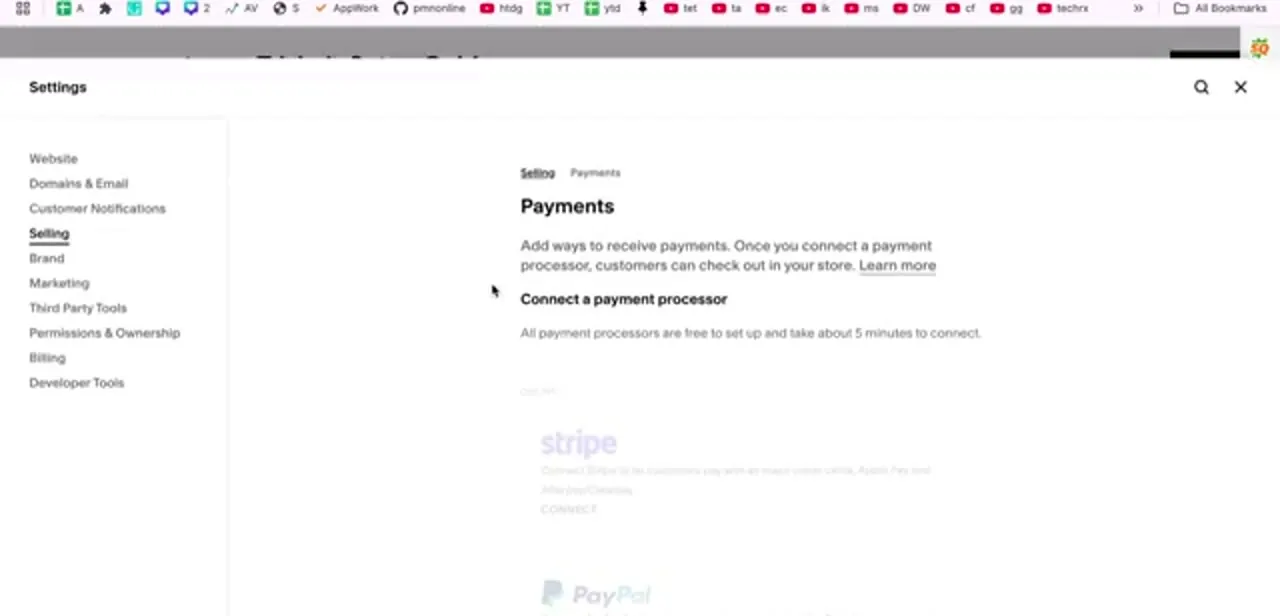
Log in at squarespace.com and open the site you're selling from — payment processors are configured per site, not per account, so a second site needs its own setup. Inside the site dashboard, open Settings and choose Selling, then Payments.
If you'd rather not hunt through the menu, typing "payments" into the dashboard search box jumps you straight there. The page opens on Connect a payment processor and notes that all processors are free to set up and take roughly five minutes each, which is accurate for the connection itself; verification on the processor's side can take longer.
02Pick between Stripe, PayPal, and Square
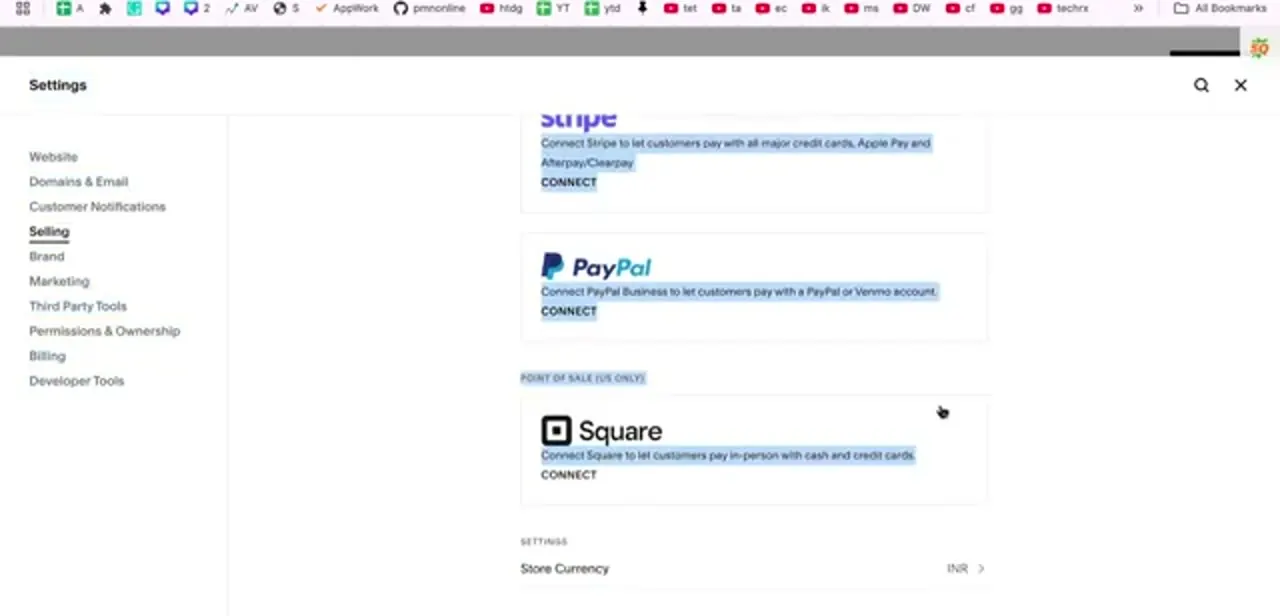
Scrolling the Payments page shows three cards, each with its own Connect button. Stripe handles all major credit cards plus Apple Pay and Afterpay/Clearpay, and it is the default choice for most sellers because it covers the widest set of online payment methods.
PayPal Business lets customers pay with a PayPal or Venmo account, which some buyers strongly prefer and others never use. Square sits in its own Point of sale section marked US only, and it exists for taking payments in person with cash and cards rather than for your online checkout. These aren't mutually exclusive — connecting Stripe and PayPal together is common and simply gives shoppers two buttons at checkout.
03Connect the processor and finish its verification
Clicking Connect hands you off to the processor's own signup, where you either log into an existing account or create one. Expect to supply business details, a tax identifier, and the bank account that will receive money — this is where the actual withdrawal path is defined, and it is on Stripe or PayPal's servers, not Squarespace's.
Both will ask for identity verification before releasing funds, typically a government ID and proof of the business address. Get this done in the same session as connecting, because an unverified processor will happily take payments while holding every payout, which is the single most common reason a seller thinks Squarespace is withholding their money.
04Set your store currency before your first sale
At the bottom of the same Payments page is Store Currency. It is worth checking deliberately, because currency is not a cosmetic setting — it determines what your customers are charged in, and it cannot be changed freely once your store has processed orders.
It also has to be a currency your chosen processor supports for your country, so a mismatch here surfaces later as declined payments rather than an obvious error message. Confirm it matches the bank account you connected, so you're not paying conversion fees on every payout.
05Understand when the money actually lands
Once a customer pays, the funds sit with the processor, not with Squarespace, and are transferred to your bank on that processor's payout schedule. Stripe typically pays out on a rolling basis after an initial holding period for new accounts, which is commonly a week or two on the first payout and shorter afterwards; PayPal keeps the balance in your PayPal account until you transfer it out, which makes it feel more manual.
Both let you set the payout cadence and see a payout history in their own dashboards. Squarespace's Orders panel shows what you sold; the processor's dashboard shows what you have been paid, and those two numbers won't match at any given moment because of timing and fees.
06Fix the usual causes of a stuck payout
When money isn't arriving, check in this order: is the processor's identity verification actually complete, are the bank details entered without transposed digits, and has the processor emailed you asking for a document you skipped. Failed bank details are the classic cause — the payment succeeds, the payout bounces, and the funds return to your processor balance silently.
Also confirm the processor is still connected in Squarespace after any password or account change, since a revoked authorization stops new orders from processing at all. Keep these details current whenever you switch banks, and re-test with one small live order rather than discovering the problem across a week of sales.
Frequently asked questions
Where is the Withdraw button in Squarespace?
There isn't one. Squarespace never holds your money — customer payments go to Stripe, PayPal, or Square, and those services pay your bank account. Withdrawals are managed in the processor's own dashboard.
Which payment processors does Squarespace support?
Stripe for cards, Apple Pay and Afterpay/Clearpay; PayPal Business for PayPal and Venmo payments; and Square for in-person point of sale, which is US only.
Can I connect more than one processor at the same time?
Yes. Running Stripe and PayPal together is common and simply gives customers both options at checkout. Each pays out to its own configured destination.
How long until my first payout arrives?
It depends on the processor, not on Squarespace. New Stripe accounts usually wait a week or two for the first payout before settling into a faster rolling schedule; PayPal holds the balance until you transfer it.
Why did my payout fail even though the sale went through?
Almost always incomplete verification or incorrect bank details on the processor's side. The charge succeeds, the transfer to your bank bounces, and the money sits in your processor balance until you correct the details.
About the author

Impran M N
I've been hooked on technology for as long as I can remember — especially the new tools and AI apps that seem to land every other week. Easy Tech Tuts is where I write up whatever I've just worked out: I do the task in the real product, record the screen, and turn it into the guide I wish I'd found first.