 Easy Tech Tuts
How to Add HTML to Squarespace Easily 2026
By Impran M N
Squarespace's built-in tools cover a lot, but sometimes you need a custom element — a styled button, a script, an embedded widget — that only custom HTML can provide. The good news is that Squarespace doesn't bury this behind a developer mode; it's a Code block, sitting in the same content panel as every other block type you already drag onto a page.
This guide walks through exactly where that block lives, what the code editor inside it looks like, and how to tell whether your HTML is actually rendering before you save and walk away. It's aimed at website owners and marketers who want more control over their site's functionality without hiring a developer for something this small.
01Open the page you want to edit
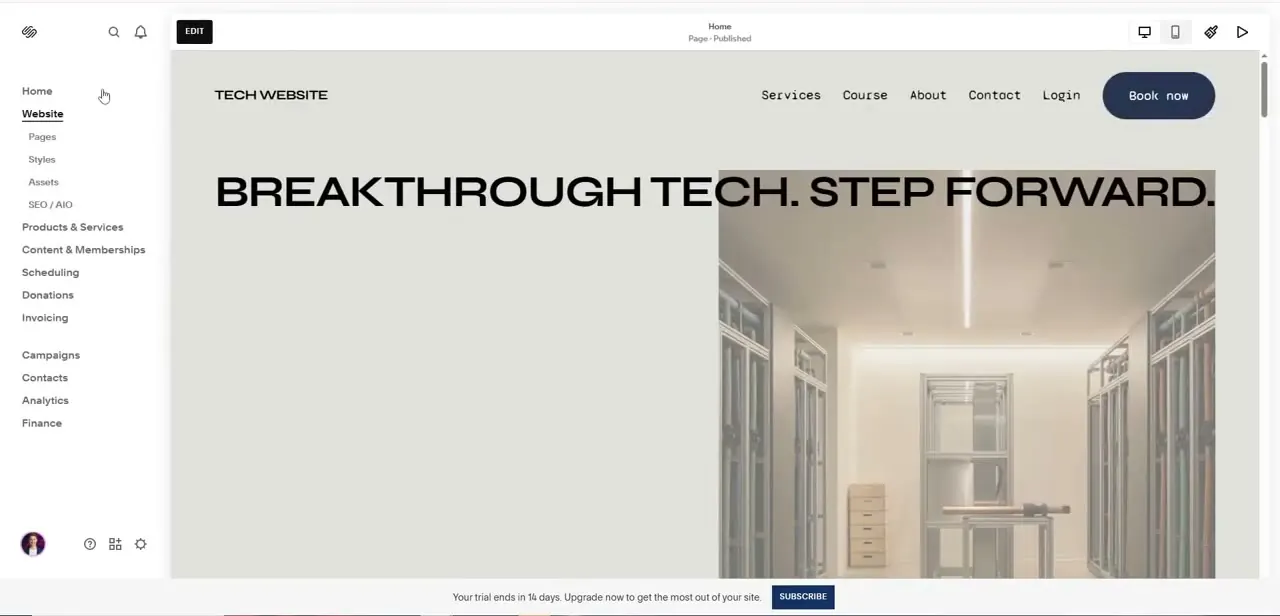
From the site dashboard, the sidebar lists Website — expandable into Pages, Styles, Assets, and SEO/AIO — alongside Products & Services, Content & Memberships, Scheduling, and more further down. Selecting Website and then a page like Home drops you into a live preview of that page with an EDIT button top left; the page header confirms its status, for example "Home — Page · Published," so you always know whether you're changing something already live. This is also where you'll notice the page's actual content for the first time — a hero section, navigation links like Services, Course, About, Contact, and a call-to-action button — which matters because your HTML block needs to sit logically among that existing content, not just anywhere convenient.
02Find the Code block in the content panel
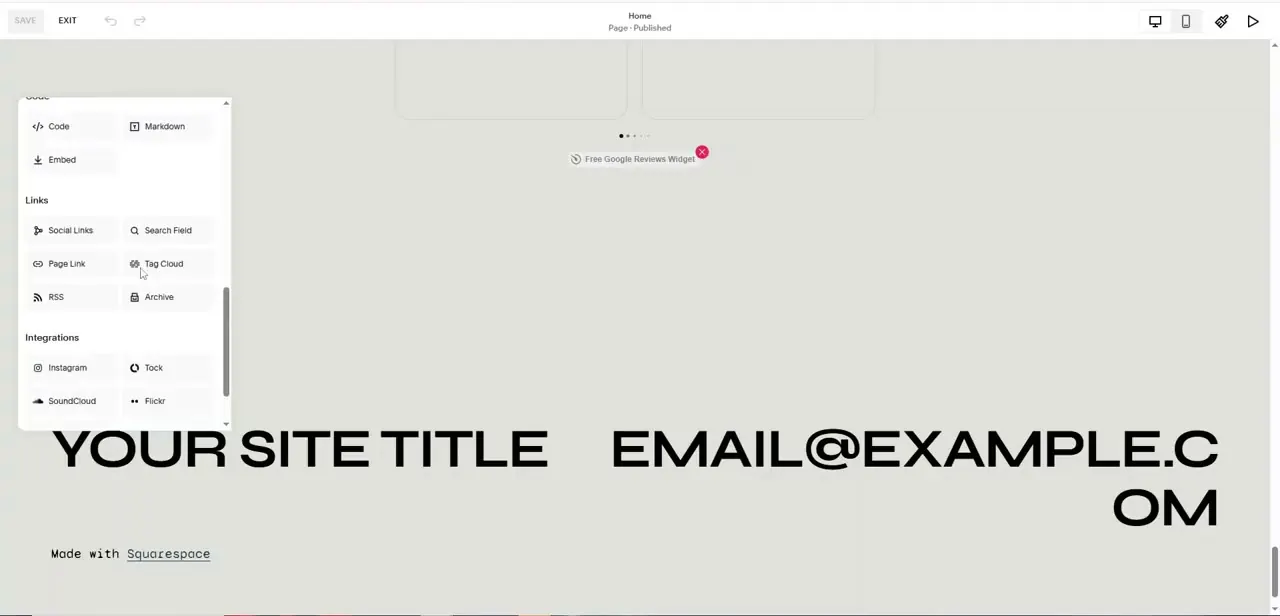
Click Edit, then the plus icon to insert a new block, and a categorized panel slides open. Under a Code heading near the top sit three relevant options side by side: Code, Markdown, and Embed — Code is what you want for raw HTML and CSS, Markdown for lightly formatted text, and Embed for pasting a URL or third-party embed snippet instead of writing markup yourself. Below that, the same panel lists Links (Social Links, Search Field, Page Link, Tag Cloud, RSS, Archive) and Integrations (Instagram, Tock, SoundCloud, Flickr), which is worth knowing exists — a lot of what people reach for custom HTML to build, Squarespace already has a native block for, and the native version usually themes better with your site.
03Write or paste your HTML into the Code block
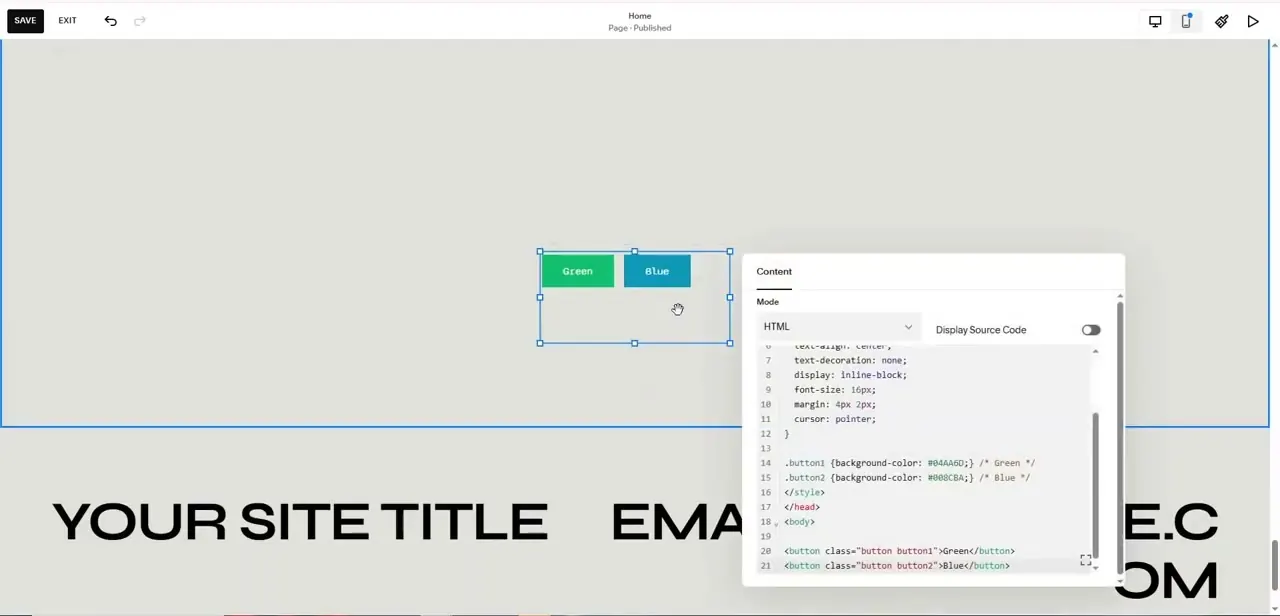
Dropping a Code block onto the page opens a Content panel with a Mode dropdown set to HTML and a "Display Source Code" toggle. The editor is a plain text area where you write real markup and CSS together — one example defines two button classes with background colors set by hex code (#04AA6D for a green button, #008CBA for blue), styling properties like border-radius, padding, and cursor, and then the actual HTML markup below it: `<button class="button button1">Green</button>` and `<button class="button button2">Blue</button>`. The block renders your code live on the canvas behind the panel as you type, so you can see the two colored buttons taking shape without leaving the editor.
04Preview before you trust it
Because the block renders inline as you edit, you get an immediate visual check, but that in-editor preview doesn't always match every device size. Use the desktop and mobile preview icons in the top toolbar to check both, since a button pair or embedded script that looks fine on desktop can overflow or misalign on a narrow mobile viewport. Save only after checking both views — the Save button sits top left next to Exit, and until you click it your HTML changes exist only in the draft state.
05Know when a Code block is the right tool
Reach for a Code block when you need something genuinely custom — a specific interactive element, a third-party script that has no native Squarespace integration, or fine-grained styling like the two-toned button example above. Reach for a native block instead when one already exists for what you're building, since Squarespace's Social Links, Page Link, RSS, and Integration blocks (Instagram, SoundCloud, Flickr, and similar) are built to inherit your site's fonts, spacing, and color palette automatically, while custom HTML has to be styled by hand to match.
06Troubleshoot when something doesn't render
If a Code block shows blank or broken, the most common cause is a syntax error — an unclosed tag, a missing closing brace on a CSS rule, or a mismatched class name between your `<style>` block and your markup. Toggle "Display Source Code" on to see your raw code rendered as text rather than executed, which is a fast way to spot a stray character. If the block renders but looks wrong, check for a class name collision with Squarespace's own theme styles — renaming your custom classes to something unlikely to already exist on the page, like a prefixed `.pmn-button1`, usually resolves it.
Frequently asked questions
Do I need coding skills to add HTML to Squarespace?
Basic familiarity with HTML and CSS helps a lot, since the Code block is a plain text editor with no visual assistance — but simple embeds can often be added by pasting existing code from elsewhere.
Can adding custom HTML break my Squarespace site?
A broken Code block typically only affects that block, not the whole page, but always check both desktop and mobile previews before saving, since layout issues are the most common problem.
What are common reasons to add HTML to a Squarespace site?
Custom buttons with specific styling, embedding a script or widget with no native integration, and fine-grained layout control are the main cases — check the Links and Integrations sections first, since many common needs already have a native block.
Is custom HTML available on all Squarespace plans?
The Code block is part of the standard content panel available when inserting blocks, alongside Markdown and Embed, so it's accessible from the same editor most Squarespace plans use.
Where exactly is the Code block located?
Click Edit on a page, then the plus icon to add a block — Code sits near the top of the panel under a "Code" heading, alongside Markdown and Embed.
About the author

Impran M N
I've been hooked on technology for as long as I can remember — especially the new tools and AI apps that seem to land every other week. Easy Tech Tuts is where I write up whatever I've just worked out: I do the task in the real product, record the screen, and turn it into the guide I wish I'd found first.