 Easy Tech Tuts
How to Fix Cloudflare Verify You Are Human, Fix Failed Loop Easily 2026
By Impran M N
Ticking the Cloudflare checkbox, watching the spinner, and landing back on the same challenge page is one of the more maddening browser failures, because nothing is broken in an obvious way. Almost always the cause is local: stale cookies from a previous challenge, a device clock that has drifted, an extension rewriting the page's scripts, or an IP address the site has learned to distrust.
This guide works through those causes in the order that resolves the most cases fastest, starting with the browser data reset that fixes the majority of loops. It ends with the one piece of information worth collecting if nothing works, so you can hand the site's owner something they can actually look up.
01Understand why a real person gets stuck in the loop
Cloudflare's challenge doesn't just check a box — it runs a short set of browser checks in the background and issues a clearance cookie when they pass. A loop means the cookie never gets set, or gets set and immediately rejected.
The usual culprits are a corrupted or expired clearance cookie left over from an earlier attempt, a system clock far enough out of sync that the cookie looks expired the moment it arrives, a privacy extension blocking the challenge's scripts or storage, or a shared IP address with a poor reputation. Each cause has a distinct fix, which is why working through them in order beats reloading the page a twentieth time.
02Open your browser's privacy and security settings
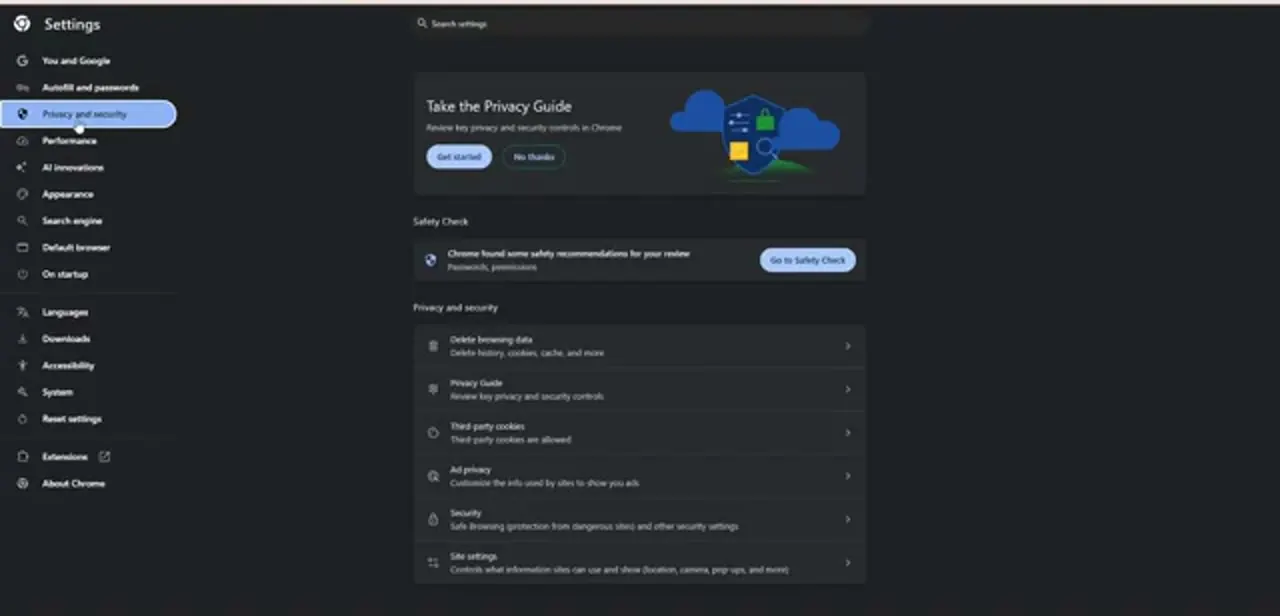
Start in the browser, since that's where most loops originate. In Chrome, open Settings and pick Privacy and security from the left sidebar.
The section that matters is Delete browsing data at the top of the list — described right there as history, cookies, cache and more. While you're on this page, note Third-party cookies and Site settings further down: if third-party cookies are blocked outright, some embedded Turnstile widgets can't store what they need, so that setting is worth checking if the loop only happens on pages where the challenge appears inside another site's form.
03Delete the cookies and cached files behind the challenge
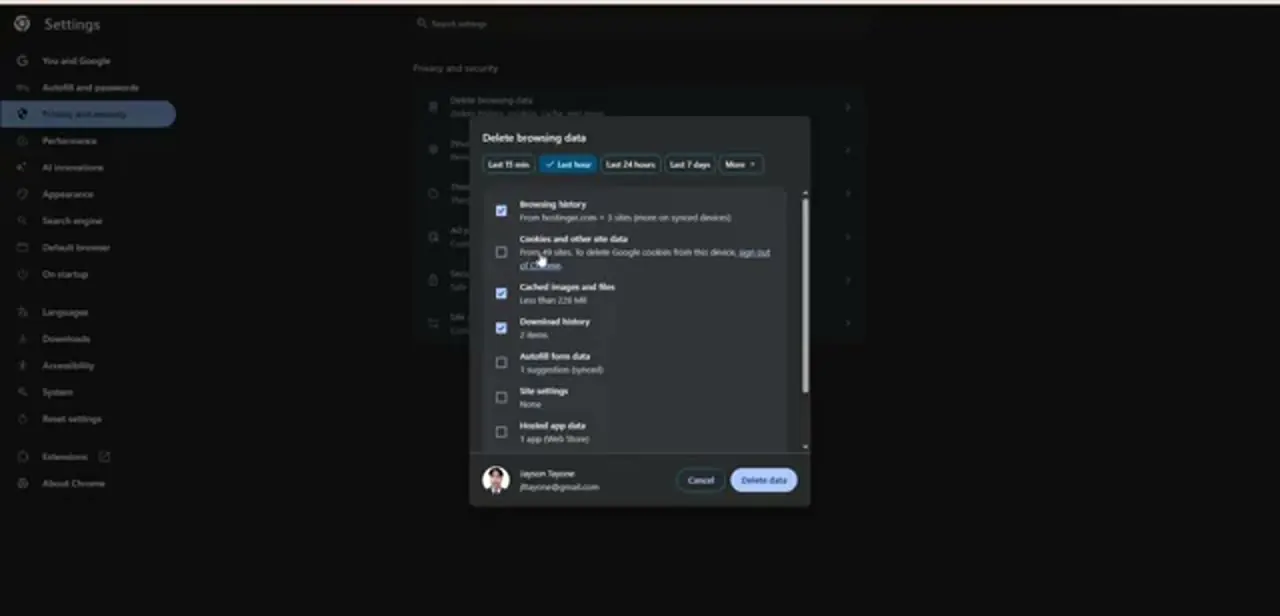
Delete browsing data opens a dialog with a time range across the top — Last 15 min, Last hour, Last 24 hours, Last 7 days, or a wider option under More — and a checklist of what to remove. Pick a range that comfortably covers when the loop began; an hour is usually plenty if it started today.
The two boxes that matter are Cookies and other site data and Cached images and files, and Cookies is the one that is easy to miss because it is often left unticked by default. Chrome tells you how many sites will be affected, so expect to sign back in to some of them. Confirm with Delete data, close every tab for the problem site, and load it fresh — a large share of loops end here.
04Check that your device clock is actually correct
This is the fix people skip and then discover was the answer. Cloudflare's clearance cookie carries a timestamp, and if your machine's clock is minutes or hours off, or set to the wrong time zone, the cookie can appear expired or not yet valid the instant it is issued — so the challenge reissues, forever.
Open your operating system's date and time settings, switch on the automatic options for both time and time zone, and use the sync button to force an immediate update against a network time server. Dual-boot machines, devices that have been powered off for months, and virtual machines drift the most. After syncing, reload the page before trying anything else.
05Rule out extensions with a clean window
Ad-blockers, script blockers, anti-fingerprinting tools and user-agent switchers all interfere with the exact signals the challenge is reading, and a user-agent switcher is especially likely to cause a hard failure because it makes your browser claim to be something it isn't. The fastest test is a private or incognito window, which starts with no cookies and, by default, no extensions running — if the site loads there, you have confirmed the problem is a local extension or stored data rather than your network. From there, open the extensions manager and disable the privacy and blocking extensions one at a time until the loop stops, then add a site exception for the one responsible instead of leaving it off.
06Change your network, and note the Ray ID if it persists
If a clean window still loops, the signal being distrusted is your IP address rather than your browser. Public VPN exit nodes and shared corporate gateways are the common offenders, since a single abusive user on the same address affects everyone behind it — disconnect the VPN, or switch to a different server, and retry.
Tethering to your phone for one load is a decisive test: if the page opens instantly on mobile data, your home or office IP is the problem, and restarting your router will often pull a fresh address. When nothing works, scroll to the bottom of the challenge page and copy the Ray ID shown there. It identifies your exact request in Cloudflare's logs, so the site's administrator can look up precisely which rule stopped you — which is far more useful in a support message than describing the loop.
Frequently asked questions
Why does Cloudflare keep failing to verify me even though I'm not a bot?
The challenge issues a clearance cookie that your browser has to accept and return. A stale cookie, a drifted system clock, an extension blocking the challenge's scripts, or a poorly-rated shared IP can each stop that from happening, which sends you back to the same page.
Which browser data should I delete to fix the loop?
Cookies and other site data plus cached images and files, for a time range covering when the loop started. Cookies is the important one and is often left unticked in the delete dialog by default.
Can my system clock really cause this?
Yes. The clearance cookie is time-sensitive, so a clock that's noticeably off can make it look expired on arrival. Turning on automatic date, time and time zone and forcing a sync resolves it.
Does using a VPN cause the verification loop?
Often. Public VPN exit IPs are shared by many people, so past abuse from that address affects everyone using it. Switching servers, disconnecting, or briefly tethering to mobile data will tell you if the IP is the cause.
What is the Ray ID and why does it matter?
It's the unique identifier for your request, printed at the bottom of the challenge page. The site's administrator can use it to find the exact log entry and see which rule blocked you, so include it in any support request.
About the author

Impran M N
I've been hooked on technology for as long as I can remember — especially the new tools and AI apps that seem to land every other week. Easy Tech Tuts is where I write up whatever I've just worked out: I do the task in the real product, record the screen, and turn it into the guide I wish I'd found first.