 Easy Tech Tuts
How to Use Gems in Gemini to Save Time With AI | Custom Assistants Explained | Easily 2026
By Impran M N
A Gem is a custom version of Gemini built around one specific job, so you're not re-explaining context every time you start a new chat for a recurring task. Instead of a general-purpose assistant you have to steer each time, a Gem remembers the instructions, tone, and steps you set up once and applies them automatically every time you open it.
For anyone doing the same category of task repeatedly — writing the same style of report, running the same kind of research, generating the same format of content — this turns a multi-paragraph prompt you'd otherwise retype into a one-click tool. This guide covers browsing Gemini's library of prebuilt Gems for ideas, then building a custom one from a single plain-language prompt, using a real multi-step example so you can see exactly what the tool generates behind the scenes.
01Understand what a Gem actually is
A Gem is essentially a saved configuration of Gemini — a set of instructions, and in some cases a defined sequence of steps, that turns a general AI chat into a purpose-built tool. Once created, it lives in your Gemini sidebar like a bookmarked assistant, ready to run without you restating the setup every time.
This is the core time-saving mechanism: the setup cost is paid once, and every future use skips straight to the task. That distinction — one-time setup versus repeated instruction — is what separates a Gem from just writing a really good prompt each time, since a good prompt still has to be written again from scratch on your next chat.
02Open the Gems gallery for inspiration
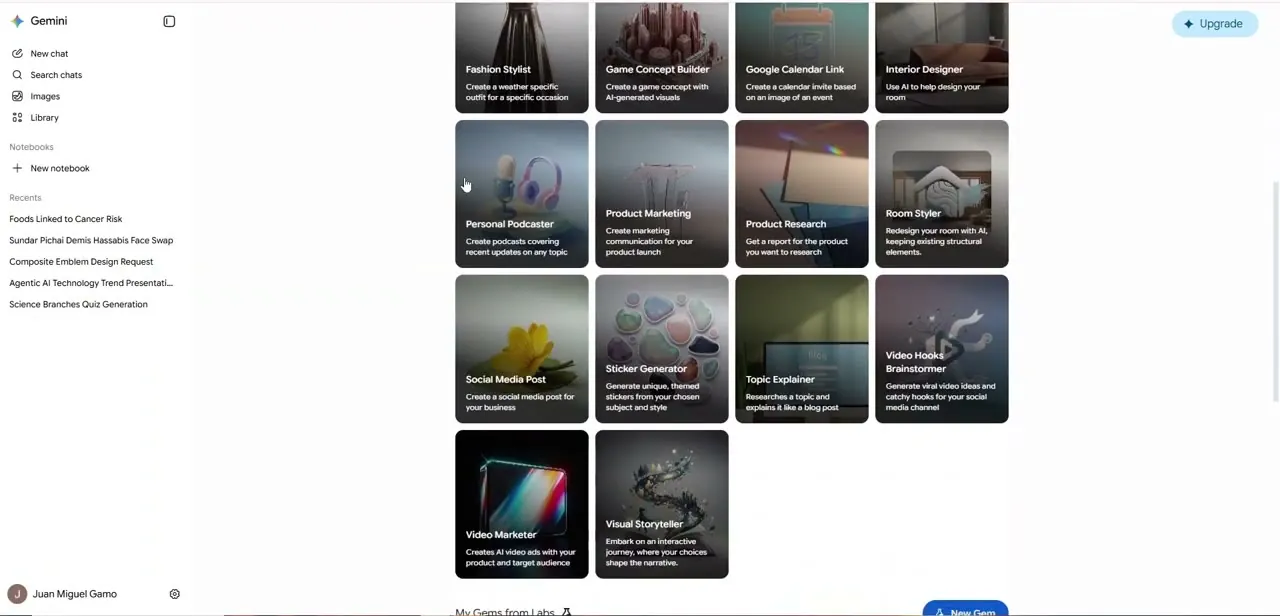
In Gemini, open the Gems section from the left sidebar to see a grid of prebuilt templates covering a wide range of jobs — a Fashion Stylist that suggests weather-specific outfits, a Product Research Gem that compiles a report on demand, a Room Styler, a Social Media Post generator, a Personal Podcaster for covering recent updates on a topic, and dozens more. Browsing this gallery before building your own is worth the few minutes it takes, since it shows you the range of what a well-scoped Gem can do and often surfaces one close enough to your need that you don't have to build from scratch. Each card includes a short description of exactly what it does, which is useful even if you end up building something custom, since it gives you a sense of how narrowly or broadly a Gem should typically be scoped to work well.
03Describe your own task in plain language
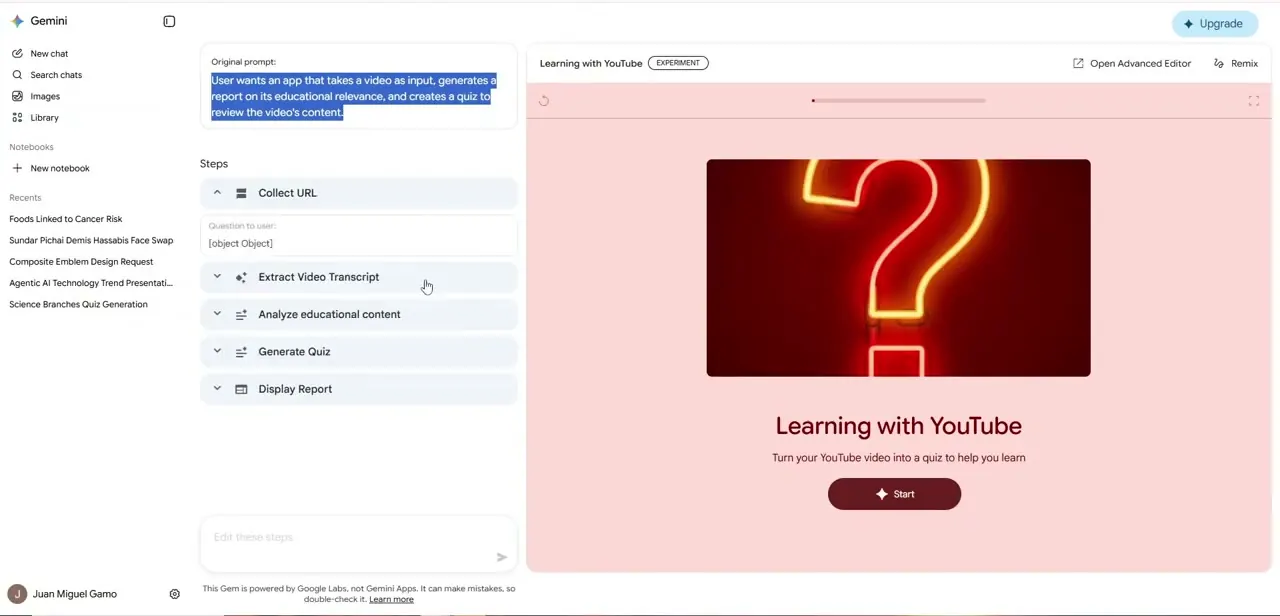
If nothing in the gallery fits, start a new Gem and describe the task the way you'd explain it to a person — what input it takes, what it should produce, and any steps in between. In the example shown here, the request was for an app that takes a video as input, generates a report on its educational relevance, and creates a quiz to review the content, described in a single sentence rather than a technical spec. Notice that the prompt doesn't specify how to accomplish any of that — no mention of extracting a transcript or structuring a report — since figuring out the steps in between is exactly what Gemini handles for you once you describe the input and the desired outcome.
04Review the steps Gemini builds automatically
From that one sentence, Gemini breaks the task into a defined sequence — in this case, Collect URL, Extract Video Transcript, Analyze educational content, Generate Quiz, and Display Report — each shown as its own expandable step in a panel next to a live preview of the resulting tool. This step breakdown is worth reading closely: it's the clearest way to confirm the Gem actually understood your intent correctly before you rely on it. The live preview panel on the right also updates as the structure comes together, showing a name for the tool and a short description, so you get an immediate sense of what the finished Gem will look like to actually use, not just how it's built internally.
05Edit the steps if something's off
Each step in the sequence can be expanded and adjusted individually, and there's a dedicated "Edit these steps" prompt box at the bottom of the panel for describing changes in plain language rather than reworking the logic by hand. If the quiz step should ask more questions, or the report needs a different focus, describe that adjustment the same way you described the original task.
06Start the Gem and test it on a real input
Click Start to try the Gem end to end, feeding it a real example of whatever input it expects — in this case, an actual YouTube link — and checking that each step in the sequence produces something usable. Note that experimental Gems built through Google Labs can behave imperfectly and are worth double-checking against the source material rather than trusting the output blindly, especially early on.
07Put time-saving Gems into your regular workflow
The real payoff shows up once a Gem is handling a task you'd otherwise repeat manually every week — turning training videos into quizzes, generating a consistent style of product research report, or drafting the same category of social post. Save the Gems you actually use often somewhere easy to find in your sidebar, and don't be afraid to keep refining a Gem's steps after the first version, since the initial build rarely needs to be perfect to already save you time.
Frequently asked questions
What exactly is a Gem in Gemini?
A Gem is a saved, purpose-built version of Gemini configured for one specific task, so you don't have to re-explain context or instructions every time you need that task done.
Can I build a custom Gem without technical skills?
Yes. You describe the task in a single plain-language sentence, and Gemini generates the step-by-step structure automatically — no coding or technical setup required.
How do I fix a Gem that isn't doing quite what I want?
Use the "Edit these steps" prompt box in the Gem's building panel to describe the change you want in plain language, rather than adjusting the underlying logic manually.
Are there Gems already built that I can use right away?
Yes. Gemini's Gems gallery includes prebuilt templates for common tasks like product research, social media posts, and room design, which are worth browsing before building a custom one.
Are experimental Gems reliable enough for business use?
They're a good starting point but should be checked against source material, especially for anything built through Google Labs, since experimental tools can behave imperfectly and are flagged as such in the interface.
About the author

Impran M N
I've been hooked on technology for as long as I can remember — especially the new tools and AI apps that seem to land every other week. Easy Tech Tuts is where I write up whatever I've just worked out: I do the task in the real product, record the screen, and turn it into the guide I wish I'd found first.