 Easy Tech Tuts
How to Create Anki Flashcards With ChatGPT | Study Faster | Easily 2026
By Impran M N
Writing flashcards by hand is the slowest part of studying, and it's usually the reason people give up on spaced repetition before it starts paying off. ChatGPT can do the tedious part for you: turn a pile of notes, a textbook chapter, or even a rough topic description into clean, exam-focused question-and-answer pairs, then hand them back in a format Anki can import directly.
This guide walks through asking ChatGPT for the right kind of notes, getting them out as an importable CSV, and the field-mapping step in Anki that trips people up the first time. It closes with the habits that make AI-generated cards actually stick instead of piling up unreviewed.
01Open ChatGPT and set the context
Start a fresh chat and tell ChatGPT who you are and what you're studying before you ask for anything. A one-line prompt like naming your course or subject area works far better than a bare "give me flashcards," because ChatGPT tailors the depth and vocabulary of what it generates to the level you describe.
If you already have source material — lecture slides, a textbook PDF, or your own written notes — say so up front and mention you'll be pasting or uploading it, since that changes how ChatGPT structures its first reply. Starting a new chat for each subject also keeps the conversation focused, so later requests for a CSV export don't get mixed up with content from an unrelated topic earlier in the thread.
02Ask ChatGPT to generate structured notes
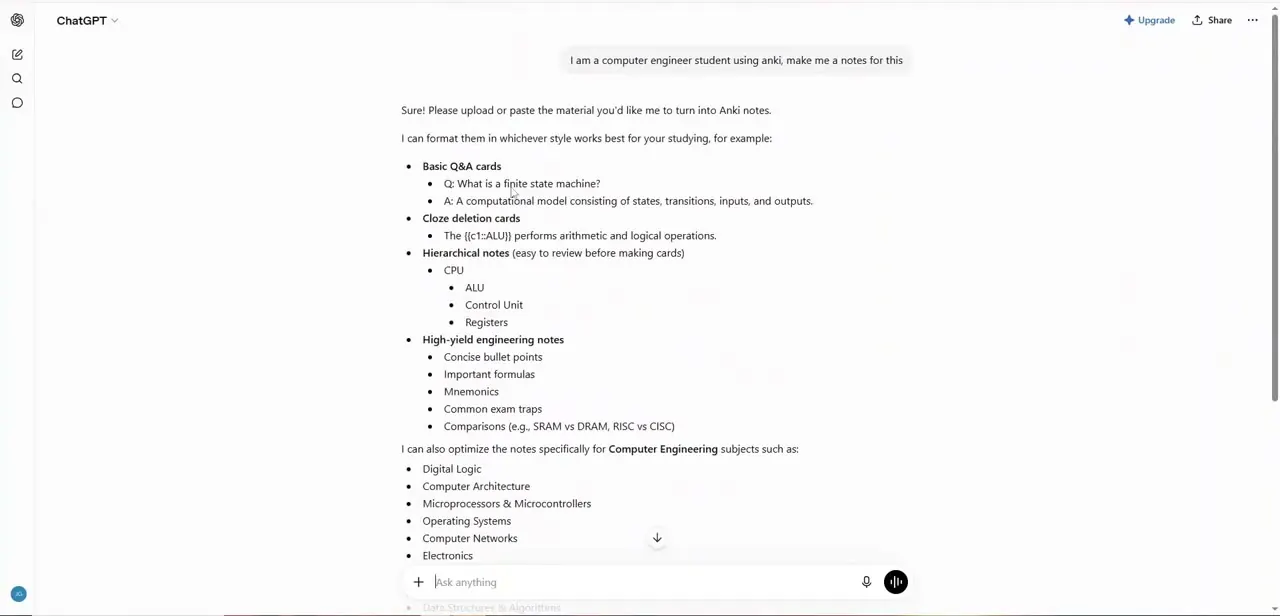
Describe your subject and ChatGPT will offer to format the material several ways rather than just dumping text at you: basic Q&A cards, cloze-deletion cards with a blanked-out term, hierarchical outline notes, or high-yield bullet points with mnemonics and common exam traps. In one real exchange, a computer engineering student asked for notes and ChatGPT laid out all four formats along with a list of relevant subjects — digital logic, computer architecture, microprocessors, operating systems, and more — so the student could pick what fit. Choosing the right format here matters more than people expect: cloze deletions suit definitions and formulas, while basic Q&A pairs suit anything conceptual, and mixing both in one deck is completely fine.
03Have ChatGPT export the notes as a CSV
Once you've settled on content, ask ChatGPT to package it as a CSV rather than copying formatted text out of the chat window by hand. Anki's importer reads plain CSV files with one card per line, so this single request saves the reformatting step almost everyone gets stuck on.
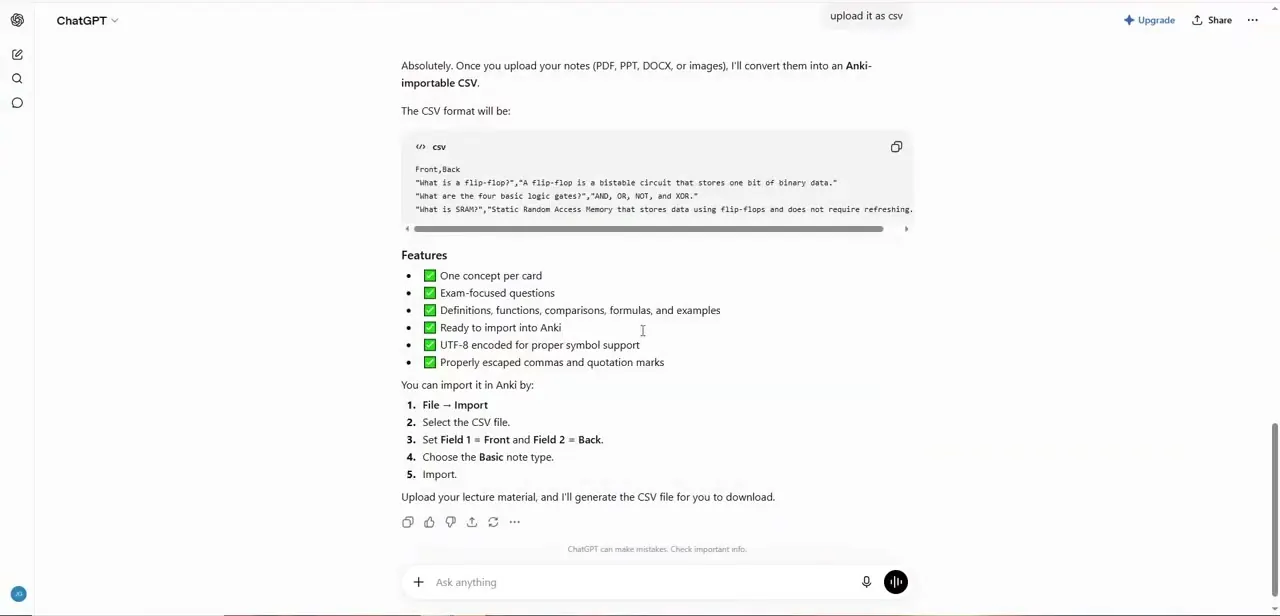
Upload your lecture material or paste it in and ChatGPT converts it into a two-column Front/Back file, properly escaping commas and quotation marks inside the text and encoding it so special symbols don't break on import. Ask it to keep one concept per card and to focus questions on exam-relevant material rather than trivia, since both directly affect how useful the deck ends up being.
04Download the CSV and check the format
ChatGPT will show you the CSV inline before you download it, with a header row of Front,Back followed by one quoted question-and-answer pair per line. Skim it before importing anything — this is the easiest point to catch a card that's too long, a definition that got cut off, or a question that doesn't actually match its answer. ChatGPT also lists what it aimed for while building the file: one concept per card, exam-focused phrasing, properly escaped punctuation, and UTF-8 encoding so accented characters or symbols display correctly once the deck is in Anki.
05Import the CSV into Anki
In Anki, go to File then Import and select the CSV file you just downloaded. The import dialog asks you to map columns to fields — set Field 1 to Front and Field 2 to Back so ChatGPT's questions land on the front of each card and the answers land on the back, then choose the Basic note type unless you specifically built cloze-deletion cards, which need the Cloze note type instead.
Pick the deck you want the cards added to before you confirm, since Anki won't sort them for you afterward. Click Import and the whole batch appears in your deck in one pass instead of one card at a time.
06Refine the cards before you study them
Run through the freshly imported deck once and edit anything that reads awkwardly out of context — ChatGPT writes fluent answers, but a phrase that made sense in the chat window doesn't always make sense as an isolated flashcard six weeks from now. Split any card that's really testing two ideas at once into two separate cards, since single-concept cards are recalled faster and more reliably than compound ones.
This pass also catches duplicate or near-duplicate cards, which show up more often than you'd expect when a topic gets covered from a couple of different angles in the same conversation. It's also the right time to add a tag for the source chapter or week, so you can filter the deck down to just the material for an upcoming quiz instead of reviewing everything at once.
07Study with spaced repetition consistently
The generation method doesn't matter if the deck sits unreviewed, so schedule short daily sessions rather than long cram blocks — Anki's default algorithm is built around frequent, spaced review, and it works best when you actually open the app most days. Rate each card honestly using the difficulty buttons instead of always tapping "good," since the whole point of the algorithm is to show you weak cards more often and strong ones less.
Because ChatGPT can regenerate a fresh batch in minutes, it's worth treating flashcard creation as an ongoing habit tied to each week's material rather than a one-time project before an exam. Professionals learning a new tool or framework for work can use the exact same rhythm — a small daily deck update beats a single overwhelming session built the night before a deadline.
Frequently asked questions
What kind of prompts work best for generating flashcards?
Name your subject and level up front, and ask specifically for the Anki-importable CSV format rather than plain text — that gets you cards ready to import in one step instead of content you have to reformat by hand.
Do I still need to edit what ChatGPT generates?
Yes. Skim the CSV before importing and do a quick pass after, splitting any card that tests two ideas at once and fixing anything that reads oddly outside the original chat context.
How do I actually get the CSV into Anki?
In Anki, choose File then Import, select the CSV, set Field 1 to Front and Field 2 to Back, choose the Basic note type (or Cloze if you generated cloze-deletion cards), pick your deck, and import.
Is this method useful for professionals learning new skills, not just students?
Yes. The same generate-then-import flow works for any subject you can describe to ChatGPT, whether that's exam material or a new tool you're picking up for work.
Can beginners use this without much technical setup?
Yes. It only requires a ChatGPT account, a free Anki install, and the built-in File → Import dialog — no plugins or scripting needed.
About the author

Impran M N
I've been hooked on technology for as long as I can remember — especially the new tools and AI apps that seem to land every other week. Easy Tech Tuts is where I write up whatever I've just worked out: I do the task in the real product, record the screen, and turn it into the guide I wish I'd found first.