 Easy Tech Tuts
Zapier vs Power Automate, Which Power Automate Alternative is the Best in AI Era 2026?
By Impran M N
Choosing between Zapier and Microsoft Power Automate usually comes down to one question: does your team already live inside Microsoft 365, or is it stitched together from dozens of independent SaaS apps? Both platforms now lean hard on AI to shorten the path from idea to working automation, but they get there differently — one through a Copilot-style prompt box, the other through an enormous app-connector library. This guide walks through what each tool's builder actually looks like, how their pricing stacks up, and where templates save you the most setup time, so you can match the platform to how your business actually works rather than picking on brand name alone.
01Start automating with Power Automate's Copilot builder
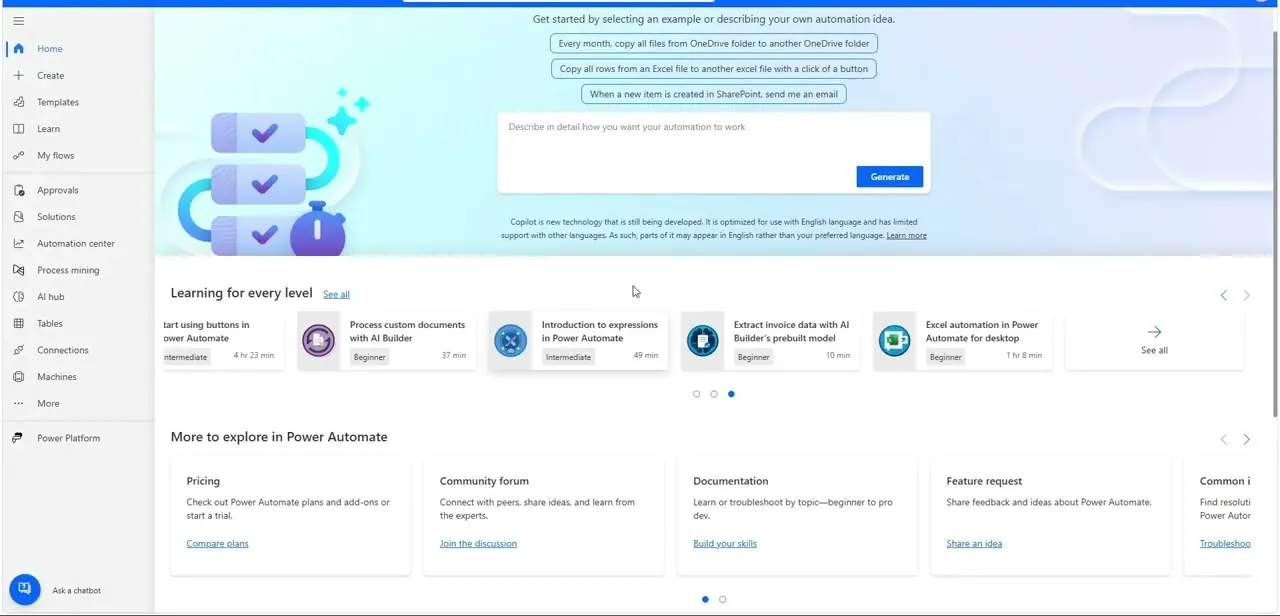
Power Automate's home screen leads with a prompt box: describe what you want automated in plain English — "copy all rows from an Excel file to another Excel file with a click of a button" is one of the suggested starters — and Copilot drafts the flow for you. This is a meaningfully different starting point than the classic trigger-and-action builder; you're writing a sentence instead of assembling steps manually. Below the prompt box sits a row of skill-building lessons (expressions, AI Builder, desktop automation) that make it clear Power Automate expects you to grow into more advanced flows over time, not just wire up one simple task and stop.
02Browse Zapier's app and tool library
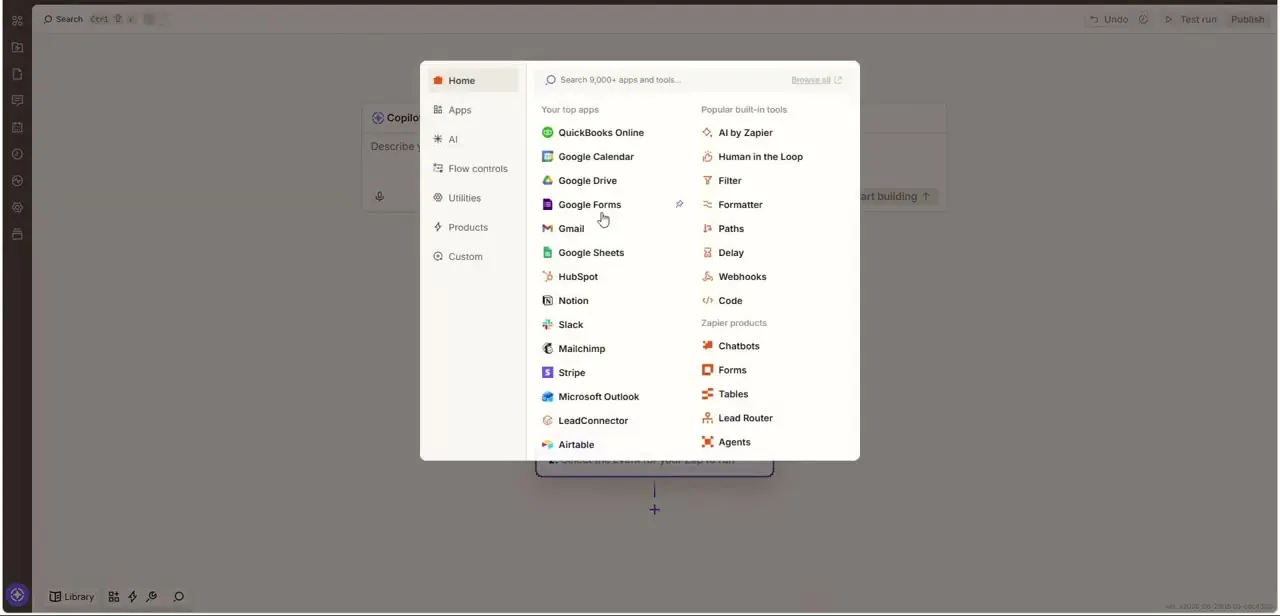
Zapier's equivalent starting point is its app search panel, opened from inside the flow editor when you're adding a new step. It lists your most-used apps first — QuickBooks, Google Calendar, Slack, HubSpot — alongside Zapier's own built-in utility tools like Filter, Paths, Delay, and Code, plus newer additions like Chatbots and Agents under "Zapier products." The panel makes Zapier's core strength obvious: breadth. With thousands of pre-built app connections searchable from one box, it's built for teams whose stack spans many small, unrelated tools rather than one unified platform.
03Compare the pricing tiers
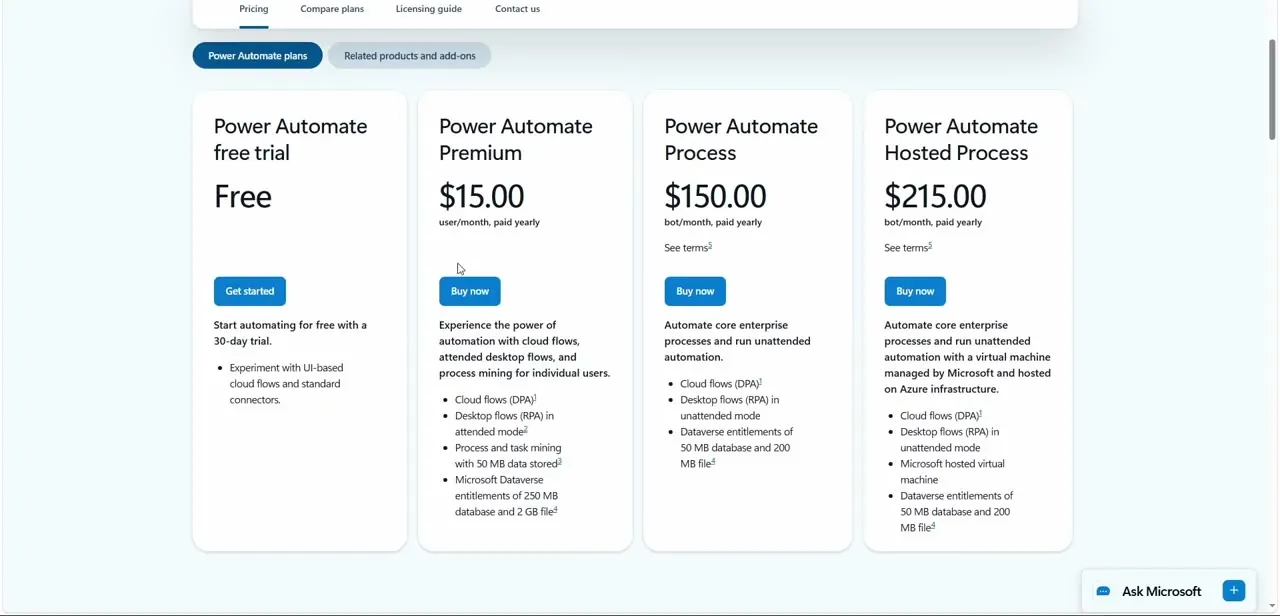
Power Automate's pricing page lays out four tiers: a free 30-day trial, Premium at $15 per user/month for cloud flows and attended desktop automation, Process at $150 per bot/month for unattended enterprise automation, and Hosted Process at $215 per bot/month, which adds a Microsoft-managed virtual machine. The jump from Premium to Process is steep, and it reflects Power Automate's per-bot licensing model rather than Zapier's per-task or per-Zap model — worth mapping against your actual flow volume before committing, since a handful of complex unattended flows can get expensive fast on Power Automate's enterprise tiers.
04Check how connections are managed
Both platforms centralize your authenticated app connections in one place so you're not re-logging into the same service for every new automation. Zapier's Connections page lists every app you've linked, with a dedicated Zap history log next to it so you can trace exactly which connection fired which run. This matters more than it sounds: when a flow breaks, the first thing you check is whether a connection expired or a permission was revoked, and having that list separate from the flow builder itself makes troubleshooting faster.
05Use templates instead of starting from a blank flow
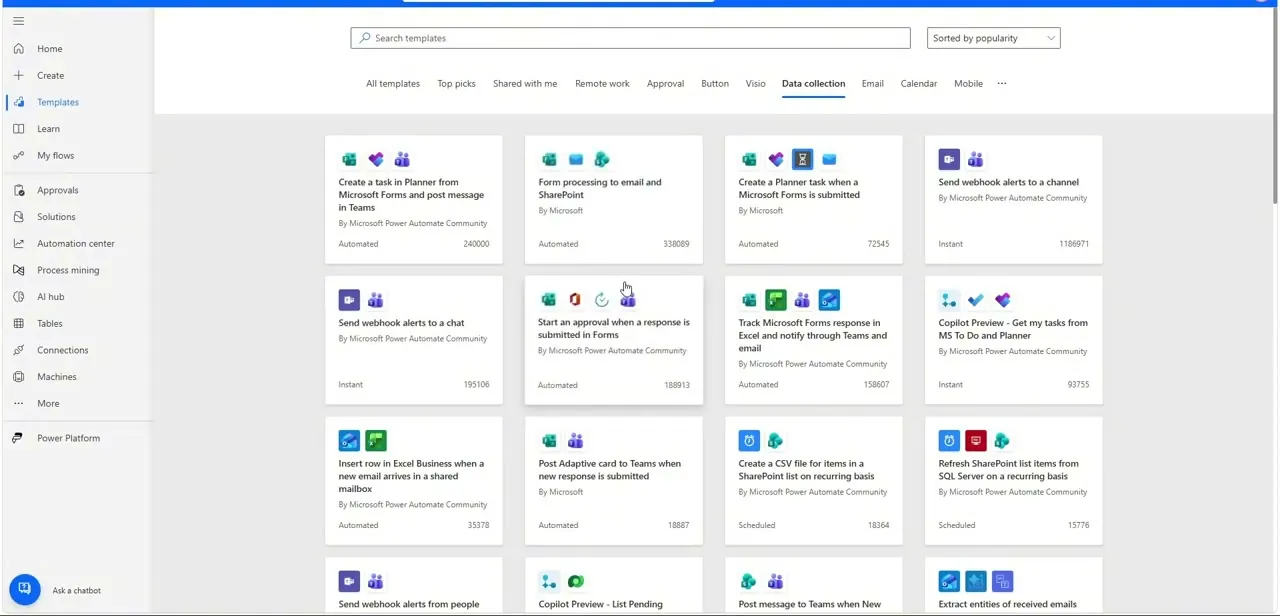
Power Automate's Templates gallery groups pre-built flows by category — Data collection, Email, Calendar, Approval — with each card showing the trigger, the apps involved, and a usage count so you can gauge how proven a template is before adopting it. Popular entries include posting Microsoft Forms responses to Teams, refreshing SharePoint lists on a schedule, and starting approvals from form submissions. If your use case is common (and most are), starting from a template here is faster than prompting Copilot from scratch and then fixing the details.
06Match the platform to your business
If your team runs primarily on Microsoft 365 — SharePoint, Teams, Outlook, Excel — Power Automate's native integration and Copilot-driven flow generation will feel faster because there's no connector tax; it talks to those apps natively. If your stack is a patchwork of independent SaaS tools with no single vendor tying them together, Zapier's connector breadth and simpler per-Zap pricing model tend to win, especially for small teams that don't need unattended desktop bots or enterprise governance.
07The final verdict
Neither platform is objectively better — they're built for different starting conditions. Power Automate is the stronger pick once you're already inside the Microsoft ecosystem and need desktop or unattended automation at scale, while Zapier is the faster on-ramp for lean teams gluing together many third-party apps with lighter, cloud-only flows. Test both on your actual highest-volume workflow with their free tiers before paying for either — the real difference shows up in how many extra steps each one needs to handle your specific apps, not in the marketing pages.
Frequently asked questions
Is Zapier or Power Automate better for Microsoft 365 users?
Power Automate, in most cases — it connects natively to SharePoint, Teams, Outlook, and Excel without needing a separate connector, and its Copilot builder is tuned for those apps.
Which platform is cheaper for a small business?
It depends on volume more than sticker price. Zapier's per-Zap pricing suits a handful of lightweight cloud automations, while Power Automate's $15/user Premium tier can be cheaper if you're already paying for Microsoft 365 licenses that include some Power Automate usage.
Do both tools use AI to build flows now?
Yes. Power Automate uses a Copilot prompt box where you describe the automation in plain English, and Zapier has added AI-powered products like Chatbots and Agents alongside its traditional trigger-and-action builder.
Can I use templates instead of building a flow from scratch?
Yes, both platforms have large template galleries. Power Automate's Templates page groups them by category with usage counts, which is a fast way to find a proven starting point for common tasks like form-to-email or scheduled data refreshes.
Does Power Automate support desktop and unattended automation?
Yes — that's one of its clearest advantages over Zapier. The Process and Hosted Process tiers ($150 and $215 per bot/month) are built for unattended RPA-style automation, including a Microsoft-managed virtual machine on the Hosted Process plan.
About the author

Impran M N
I've been hooked on technology for as long as I can remember — especially the new tools and AI apps that seem to land every other week. Easy Tech Tuts is where I write up whatever I've just worked out: I do the task in the real product, record the screen, and turn it into the guide I wish I'd found first.