 Easy Tech Tuts
How to Get Monday.com API Key Easily 2026
By Impran M N
Every custom script, automation agent, or third-party integration that talks to Monday.com needs a personal API token to authenticate. Monday.com doesn't put this anywhere near the boards you use daily — it lives inside account-level Administration settings, which is exactly why people go looking under Developer menus or Apps first and come up empty. This guide walks the real click path from your profile avatar to the token screen, explains what you're looking at once you're there, and covers the security habits worth building in before you paste that token into anything.
01Open the account menu from your profile avatar
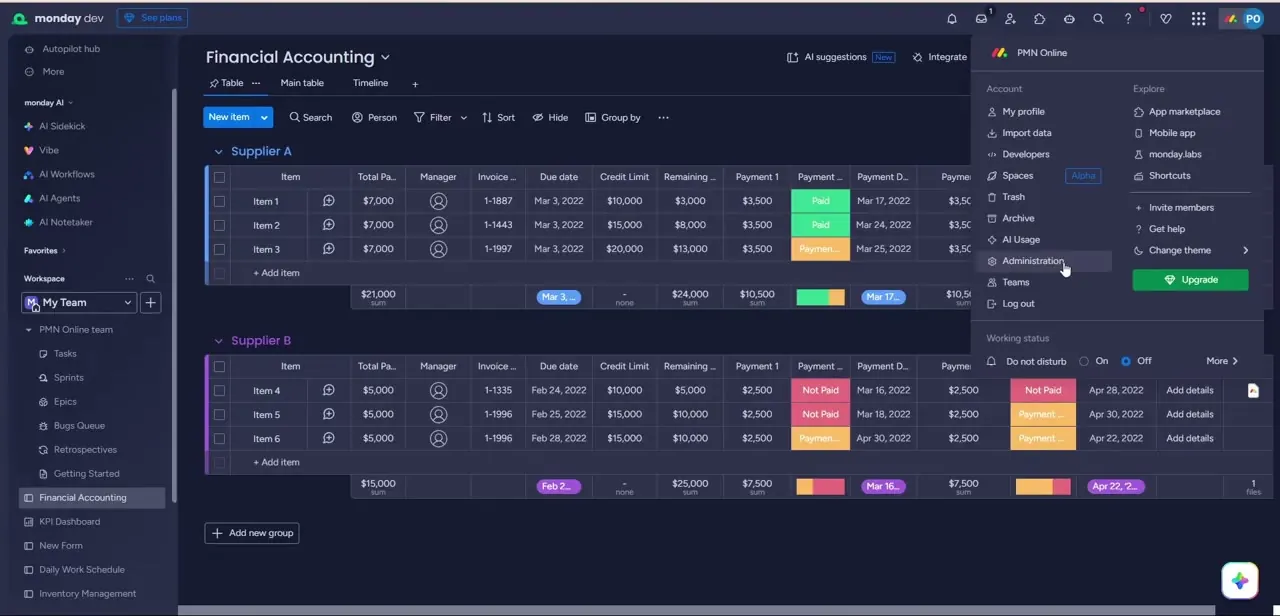
Click your avatar in the top-right corner of any Monday.com workspace to open the account panel. It's split into two columns — Account on the left with items like My profile, Import data, and Developers, and Explore on the right with the app marketplace and mobile app links. The item you actually want, Administration, sits in the Account column below Developers, which trips people up because "Developers" looks like the obvious choice but leads to a separate app-building area instead of your personal token.
02Go to Connections, then Personal API token
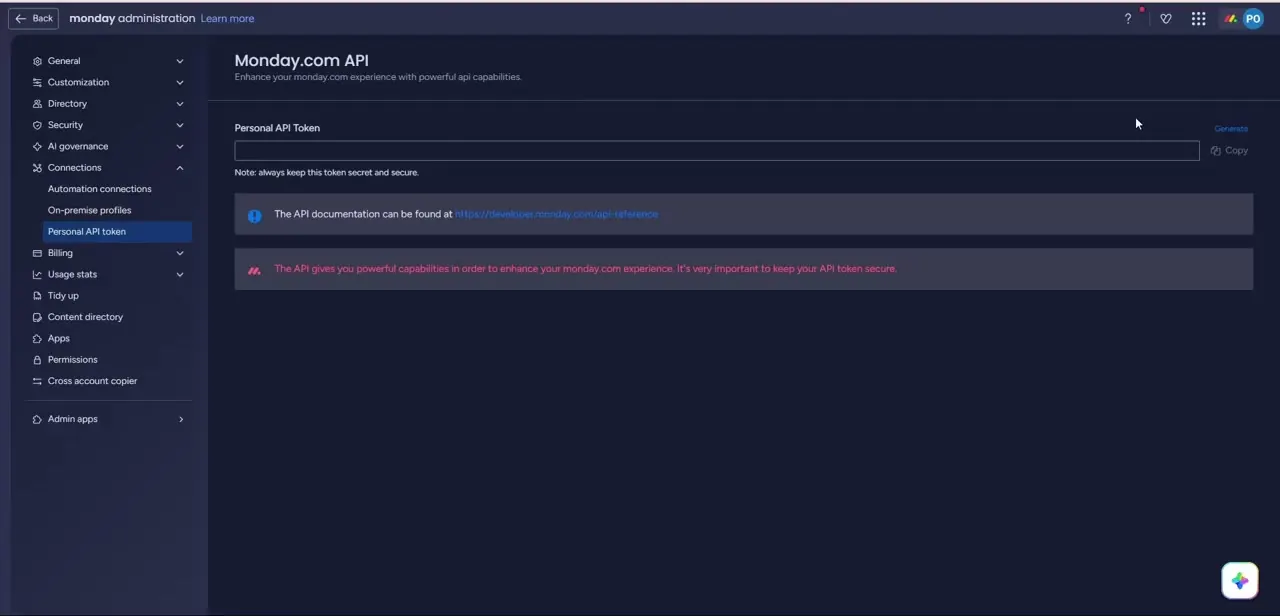
Inside Administration, the left sidebar groups settings under headings like General, Customization, Directory, Security, and Connections. Expand Connections and you'll find three entries: Automation connections, On-premise profiles, and Personal API token — the last one is where you're headed.
Clicking it loads the Monday.com API page, which has a single input labeled Personal API Token, a Generate link above it, and a Copy button beside it. A blue note links out to the API documentation, and a red banner warns that the token grants powerful access to your account, so it needs to be treated like a password.
03Generate the token and copy it immediately
With the field empty, click Generate. Monday.com fills the box with a long signed string — this is your personal token, tied to your user account and its permission level, not to a specific board or workspace.
Click Copy right away and paste it straight into wherever it needs to live, such as an environment variable, a secrets manager, or the header of your script. Don't leave it sitting in a chat message or a plain text file; once it's copied, move it into secure storage before doing anything else with it.
04Understand what the token can and can't do
A personal API token inherits your own user permissions across the account — if you can see a board, edit an item, or manage automations manually, your token can do the same thing through the API. This is different from an OAuth app credential, which is scoped to whatever permissions a user explicitly grants during an install flow.
For a personal script or a local automation agent only you will run, the personal token is the simpler path. For anything you plan to distribute to other users or connect on their behalf, look at building an OAuth app instead so you're not handing out access tied to your own account.
05Test the connection before building on top of it
Before wiring the token into a larger workflow, send one simple authenticated request to Monday.com's GraphQL API endpoint — a query for your own account name or user ID is enough to confirm the token works and that you're pointed at the right API URL. Catching an authentication problem at this stage, with one request, is far faster than debugging it inside a half-built integration with multiple moving parts.
06Regenerate the token if it's ever exposed
If a token ends up somewhere it shouldn't — committed to a public repository, pasted into a shared document, or used in a script that got copied around — go back to the same Personal API token screen and click Generate again. Monday.com issues a fresh token and immediately invalidates the old one, which cuts off anything still using it. Update every place that referenced the old token afterward, since regenerating breaks those connections until you swap in the new value, and check your workspace's activity log for anything that looks like it came from the compromised key.
Frequently asked questions
Where do I find my Monday.com API key?
Click your profile avatar, choose Administration, then open Connections → Personal API token. Click Generate to create one and Copy to grab it.
Is a personal API token the same as an OAuth token?
No. A personal token inherits your own account permissions and is meant for scripts or automations you run yourself. OAuth tokens are scoped per app and per user consent, and are the right choice for integrations you distribute to others.
What happens if I regenerate my API token?
Monday.com immediately invalidates the old token and issues a new one. Any script, integration, or agent still using the old value will stop authenticating until you update it with the new token.
Can I limit what my API token can access?
A personal token mirrors your own user permissions across the account rather than offering granular scopes. If you need tighter, per-integration access control, build an OAuth app instead.
Is it safe to put my Monday.com token in a script?
Only if it's stored as an environment variable or in a secrets manager, never hardcoded in plain text or committed to version control. Treat it with the same caution as a password, since it grants full access to whatever your account can see.
About the author

Impran M N
I've been hooked on technology for as long as I can remember — especially the new tools and AI apps that seem to land every other week. Easy Tech Tuts is where I write up whatever I've just worked out: I do the task in the real product, record the screen, and turn it into the guide I wish I'd found first.