 Easy Tech Tuts
How to Use HubSpot Integration With QuickBooks Online Easily 2026
By Impran M N
Sales teams live in HubSpot and finance teams live in QuickBooks, and without a connection between the two, the same customer gets typed in twice and invoices lag behind what sales already closed. The integration is set up from HubSpot's side rather than QuickBooks', which surprises people expecting to find it in the QuickBooks app menu. This guide walks through where the connection actually starts, what confirmation looks like once it's authorized, and the sync setup you still need to finish afterward.
01Confirm your QuickBooks Online account is ready
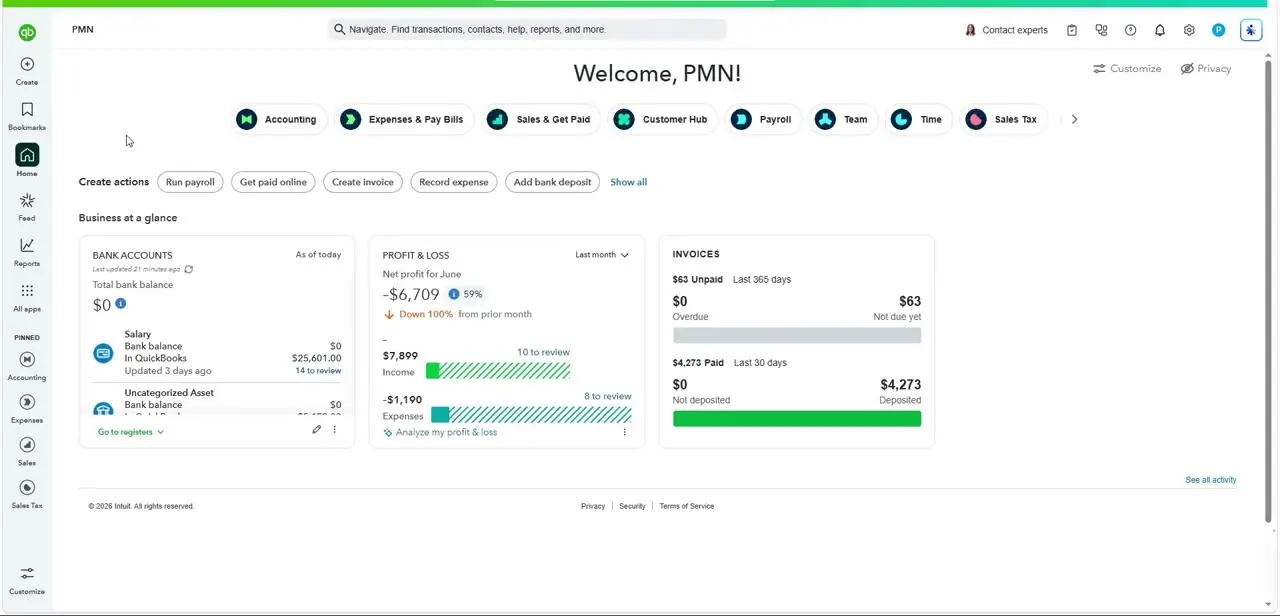
Log into QuickBooks Online first and take stock of what's already there — the Business overview shows bank balances, profit and loss, and outstanding invoices in one glance. You don't need to change anything here before connecting HubSpot, but knowing your current invoice and customer counts gives you a baseline to check against once records start syncing in from HubSpot. This is also a good moment to make sure your customer list in QuickBooks doesn't already have duplicate entries, since the integration will try to match by name and duplicates on either side create messy matches.
02Start the connection from inside HubSpot
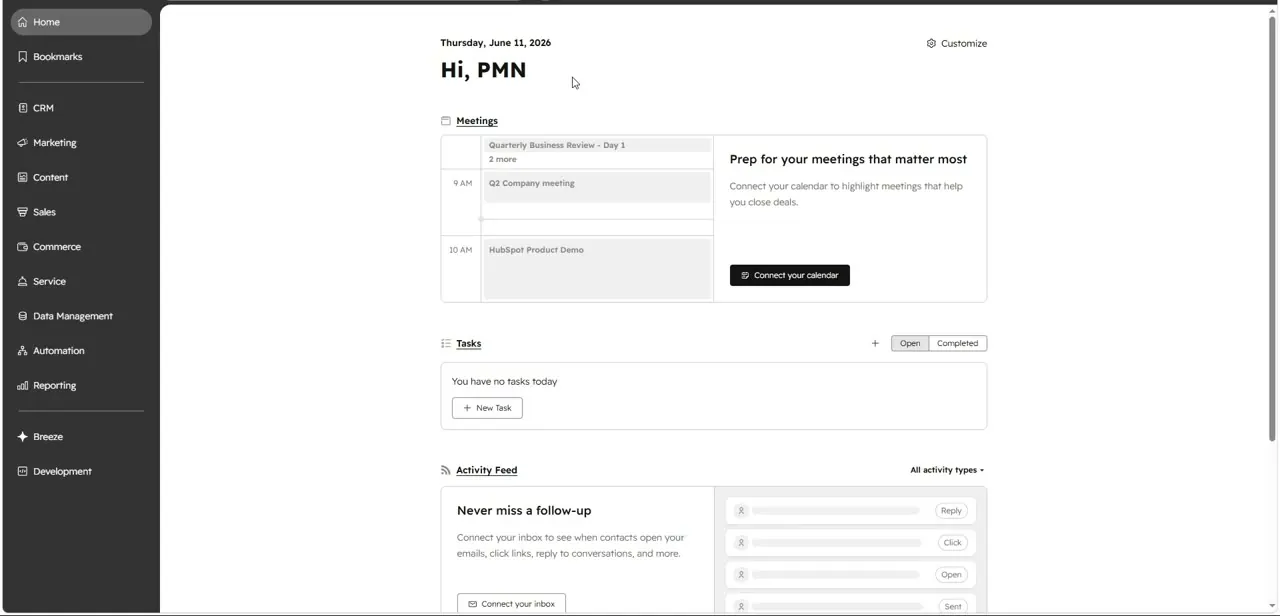
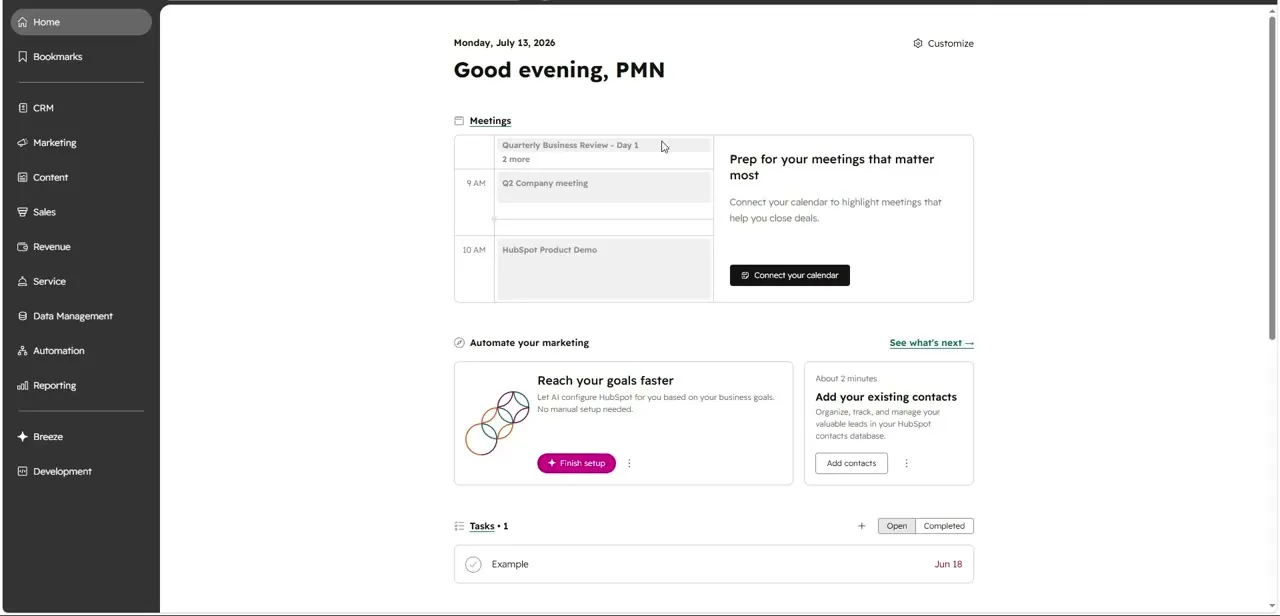
Log into HubSpot and you'll land on its home dashboard, with meeting prep, marketing automation prompts, and open tasks laid out across the page. The left-hand navigation is organized into CRM, Marketing, Content, Sales, Revenue, Service, Data Management, Automation, and Reporting — the QuickBooks connection lives under the App Marketplace, reachable from Data Management or by searching "QuickBooks" directly in HubSpot's marketplace search. This is the opposite direction from most accounting integrations, where the connection usually starts on the accounting side.
03Authorize QuickBooks Online from the marketplace listing
Find the QuickBooks Online listing in HubSpot's App Marketplace and click through to connect it. HubSpot redirects you to Intuit's sign-in page to authorize access to your QuickBooks company — the same OAuth handoff QuickBooks uses for any third-party app, so your QuickBooks password never passes through HubSpot directly. Once authorized, sign back into HubSpot and you'll land on a confirmation modal.
04Confirm the connection and move to sync setup
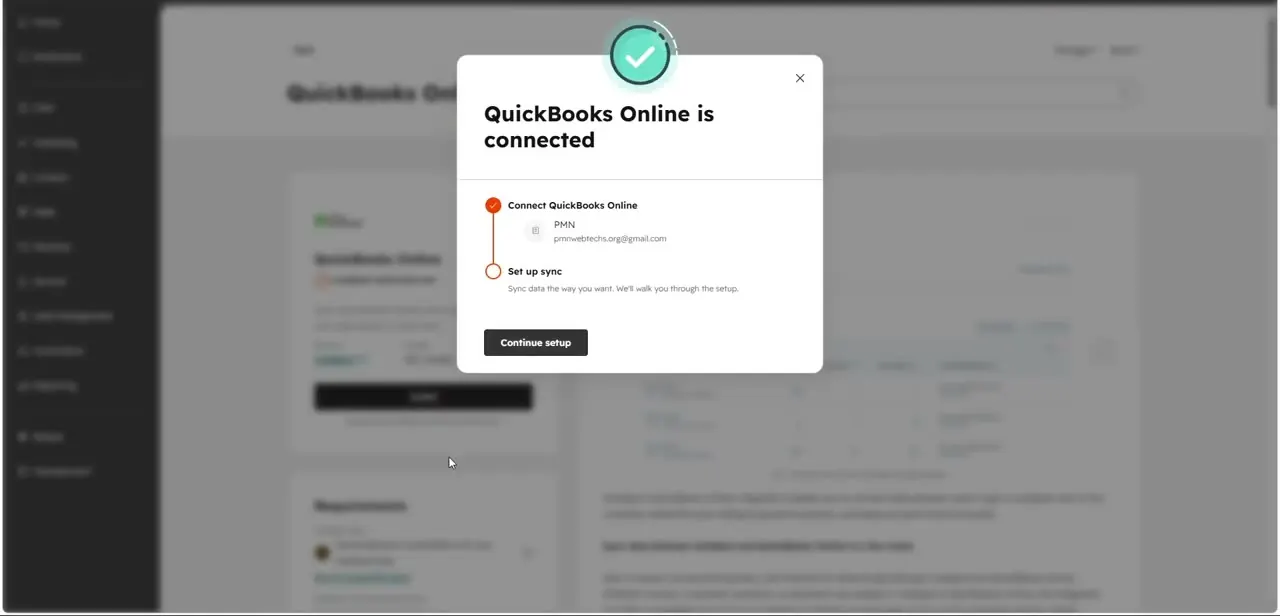
A "QuickBooks Online is connected" modal appears once authorization succeeds, showing your connected QuickBooks company name and the email tied to the account, with a checkmark against "Connect QuickBooks Online" and a second step below it labeled "Set up sync" still unchecked. This two-step layout matters: being connected is not the same as being synced. Click Continue setup rather than closing the modal, since leaving it half-finished means HubSpot and QuickBooks are authorized to talk but nothing is actually flowing between them yet.
05Choose what syncs and in which direction
The sync setup walks you through which objects move between the two systems — typically contacts, companies, products, and invoices — and in which direction. Decide early whether HubSpot or QuickBooks should be the source of truth for customer records, because syncing both ways without a clear priority leads to fields silently overwriting each other. Most teams sync contacts and deals from HubSpot into QuickBooks as customers and invoices, while letting payment status flow back from QuickBooks into HubSpot so sales can see who's actually paid.
06Check the data after the first sync
Once sync setup finishes, give it time to run its first pass and then check both systems rather than assuming it worked. In QuickBooks, look for new or updated customers matching your HubSpot contacts; in HubSpot, check that invoice status or payment fields are populating on the relevant deal records. If a contact doesn't match cleanly — a typo in a company name, or a contact that exists in one system but not the other — the sync usually flags it for manual review instead of guessing, so check the integration's error or sync-log view for anything sitting unresolved.
Frequently asked questions
Do I set up the HubSpot-QuickBooks connection from HubSpot or QuickBooks?
From HubSpot. The QuickBooks Online connector lives in HubSpot's App Marketplace, and authorizing it redirects you to Intuit's sign-in page rather than starting inside QuickBooks itself.
Is being "connected" the same as data actually syncing?
No. The confirmation modal shows connection and sync setup as two separate steps — you have to complete "Set up sync" afterward before any contacts or invoices actually move between the systems.
Which system should be the source of truth for customer data?
That's a choice you make during sync setup. Most teams treat HubSpot as the source for contacts and deals, syncing them into QuickBooks as customers and invoices, while payment status flows back the other way.
What can I automate by connecting HubSpot and QuickBooks Online?
Once synced, you can automate invoice creation from closed deals, keep customer records consistent across both systems, and see payment status directly on HubSpot deal records.
What happens if a contact doesn't match between the two systems?
The sync typically flags unmatched or conflicting records for manual review rather than guessing, so check the integration's sync log for anything sitting unresolved after the first run.
About the author

Impran M N
I've been hooked on technology for as long as I can remember — especially the new tools and AI apps that seem to land every other week. Easy Tech Tuts is where I write up whatever I've just worked out: I do the task in the real product, record the screen, and turn it into the guide I wish I'd found first.