 Easy Tech Tuts
How to Format Text in Microsoft Loop Easily 2026
By Impran M N
Unformatted walls of text make it hard for teammates to scan a Loop page and find what matters. This guide covers the main ways to format text in Loop — the floating inline toolbar, the color and background menu it opens into, and markdown-style shorthand — so your documentation stays clear and easy to read without slowing down the writing itself.
01Highlight text to reveal the inline toolbar
Click into any text block on a Loop page and select the specific words or sentence you want to style. The moment you select text, a small floating toolbar appears directly above the highlighted selection with Bold, Italic, Underline, Strikethrough, a text-color icon, and a link button — no menu-hunting required. This inline toolbar is the fastest path for one-off formatting in the middle of writing, since it appears exactly where your cursor already is instead of pulling you away to a sidebar.
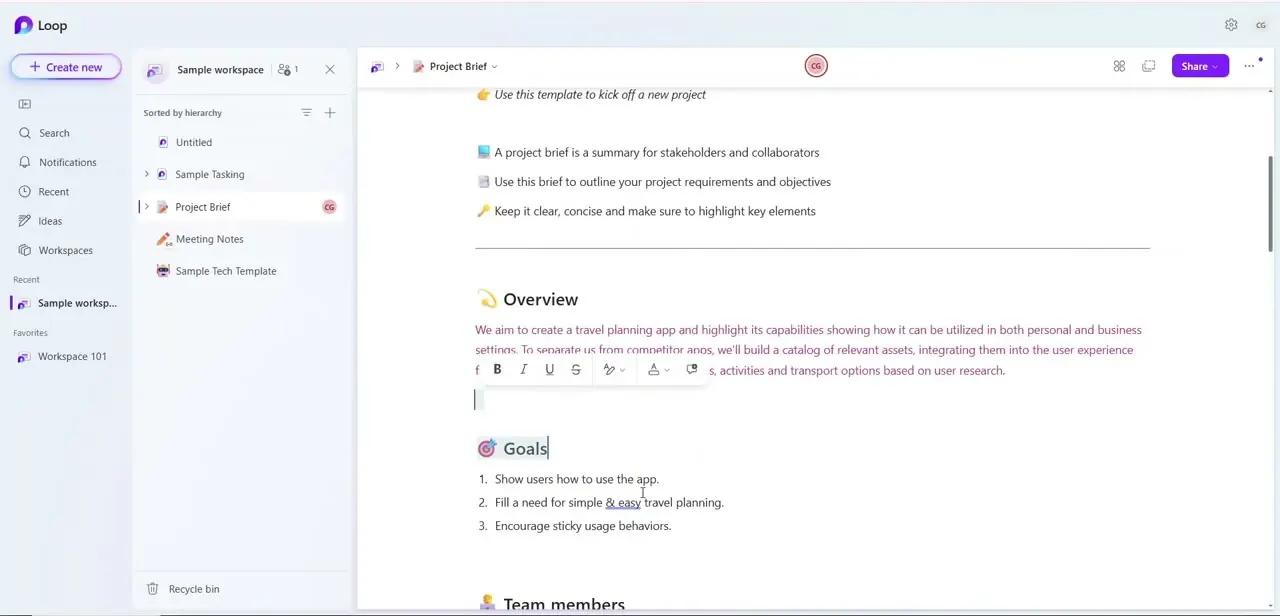
02Apply formatting from the bottom toolbar in a block
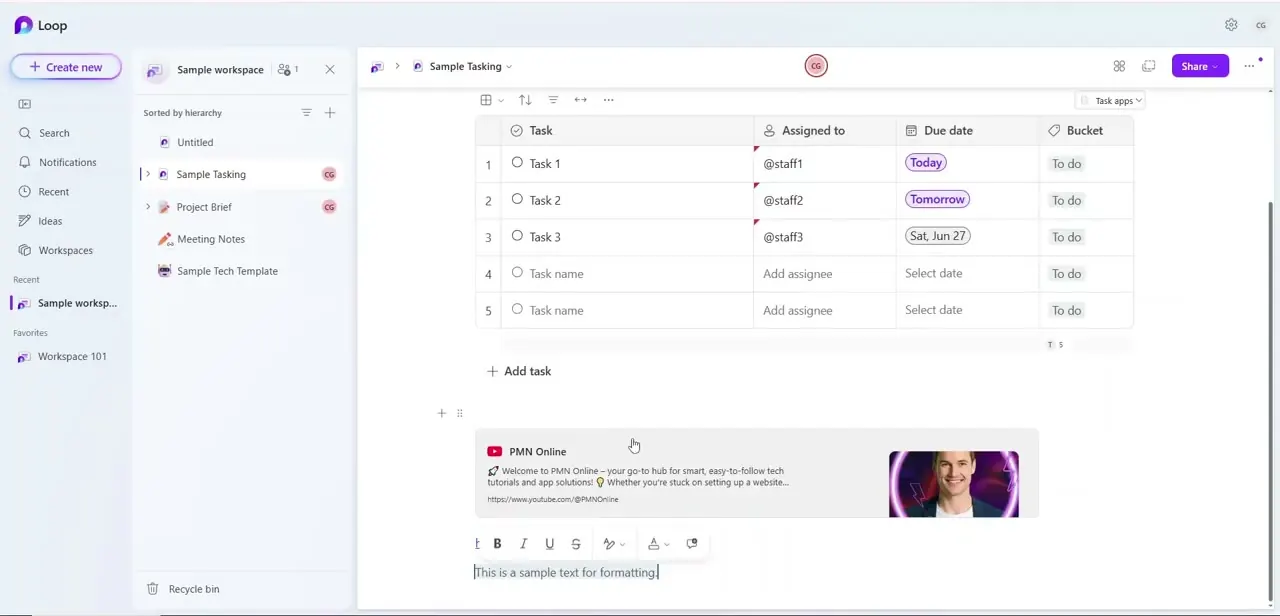
The same B I U S formatting controls also appear in a persistent bar directly beneath certain content blocks, like the sample text field under a task table. Typing into that field and clicking Bold or Italic there works identically to the floating inline version — it's simply anchored to the block instead of appearing on selection, which is useful when you're formatting as you type rather than going back to style something you already wrote.
03Open the color and background menu for more control
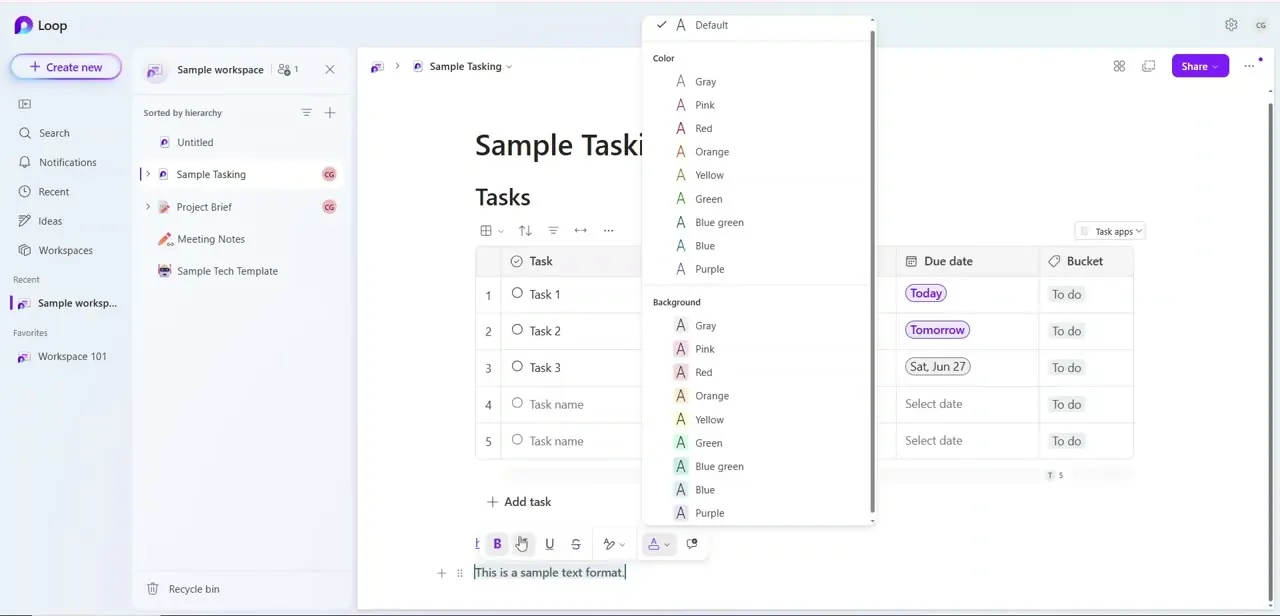
Clicking the text-color icon in either toolbar expands into a full menu split into two sections — Color, for the text itself, and Background, for a highlight behind it — each offering the same row of options: Gray, Pink, Red, Orange, Yellow, Green, Blue green, Blue, and Purple. This is where formatting goes beyond bold and italic into visual organization, letting you color-code categories, flag risks in red, or highlight a key decision in yellow so it's impossible to scroll past without noticing.
04Use keyboard shortcuts for speed
Once you know the toolbar options, the keyboard shortcuts behind them are faster for anyone doing heavy editing. Ctrl+B on Windows or Cmd+B on Mac bolds the current selection instantly, with the same pattern extending to I for italic and U for underline, letting you format without ever taking your hands off the keyboard. These shortcuts apply to whatever text is currently selected, so the workflow is the same as the toolbar — select, then trigger the style — just without the extra click.
05Use markdown shorthand for headings and lists
Beyond character-level styling, Loop recognizes markdown-style shorthand for structure. Typing a hash mark followed by a space at the start of an empty line converts it into a heading, with additional hash marks producing smaller heading levels. A hyphen or a number followed by a space similarly converts the line into a bulleted or numbered list item as you type, which is considerably faster than reaching for a list button in a toolbar every time you start a new item.
06Review the page for consistent structure
Once the content is styled, scroll back through the page and check that heading levels are used consistently — don't mix a top-level heading with a smaller one for sections that should read as equals — and that color use stays purposeful rather than decorative. A page where every other line is a different color stops communicating anything; reserve color for the handful of things that genuinely need to stand out. Loop syncs all of this styling live, so the version teammates see updates the moment you finish.
Frequently asked questions
What's the fastest way to bold text in Microsoft Loop?
The keyboard shortcut Ctrl+B on Windows or Cmd+B on Mac is the quickest way to bold highlighted text without opening a menu.
Can I create headings without using the toolbar?
Yes, typing # followed by a space on an empty line instantly converts it into a heading using markdown shorthand.
Does text formatting sync in real time for other collaborators?
Yes, Loop's multiplayer engine renders styling changes instantly across shared channels as you apply them.
Can I copy formatting from one block to another?
You can use standard copy-paste to carry over formatted text, which helps match structural styling across different sections of a page.
Can I change both the text color and its background highlight at once?
Yes, the color menu opened from the toolbar has separate Color and Background sections with the same palette, so you can set a text color and a highlight behind it independently.
About the author

Impran M N
I've been hooked on technology for as long as I can remember — especially the new tools and AI apps that seem to land every other week. Easy Tech Tuts is where I write up whatever I've just worked out: I do the task in the real product, record the screen, and turn it into the guide I wish I'd found first.